Aviation
A safety program your crews will actually use
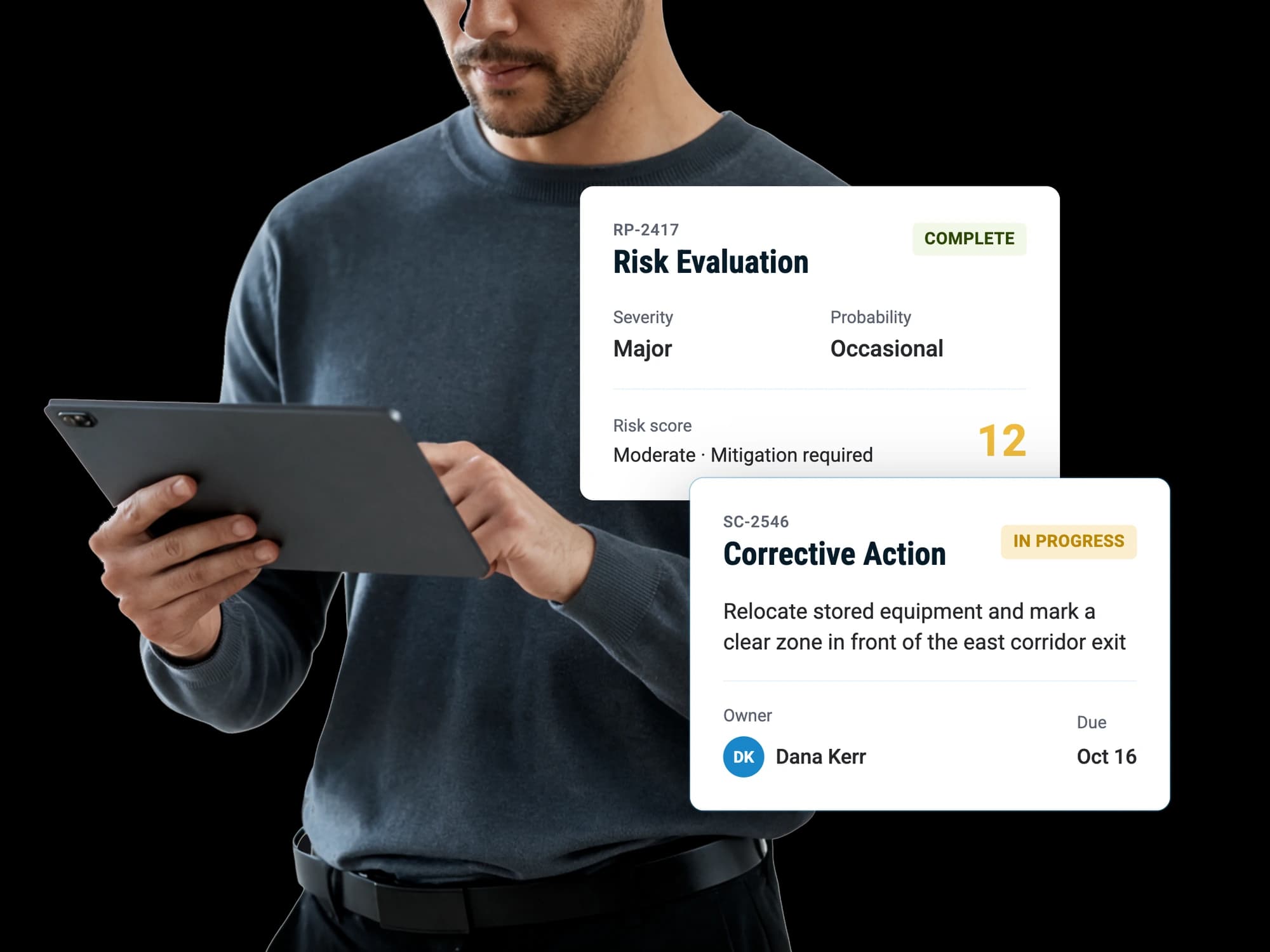
Hazard reporting from the flight deck, risk assessed the same way every time, corrective actions closed and verified, and a clear view of what your safety data is telling you.
Aviation
Hazard reporting from the flight deck, risk assessed the same way every time, corrective actions closed and verified, and a clear view of what your safety data is telling you.
Reports come in. Someone assesses them, usually well. Then the trail goes quiet, and when an auditor asks what happened next, the answer has to be reconstructed from memory and a shared drive.
Operators holding more than one certificate run them in one place, without a separate system per operation.
A chief pilot doubling as safety manager can run it alone, and a safety department can run it across every base.
The record is complete because it was built properly the first time, not assembled the week before an audit.
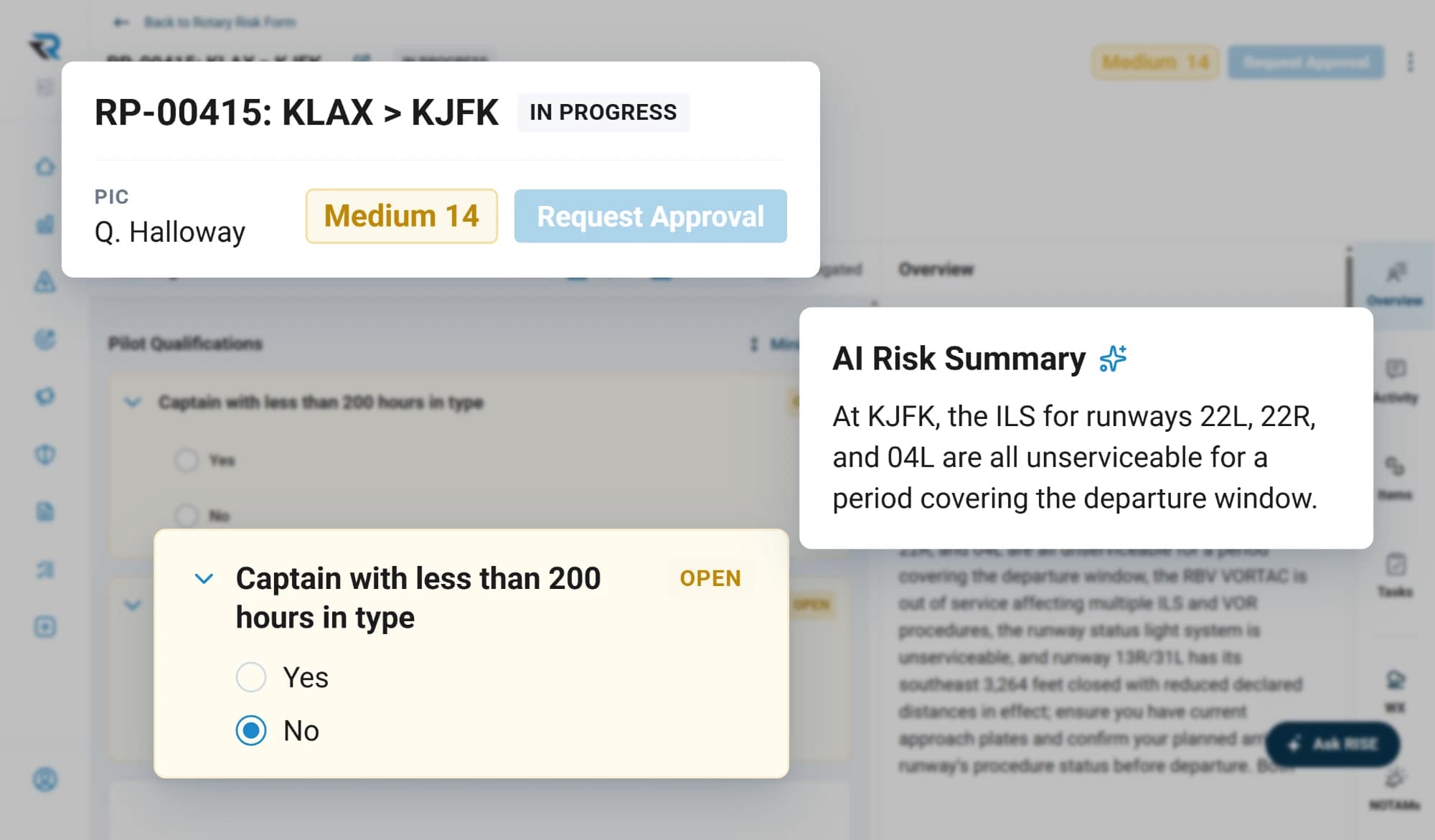
Flight risk assessments
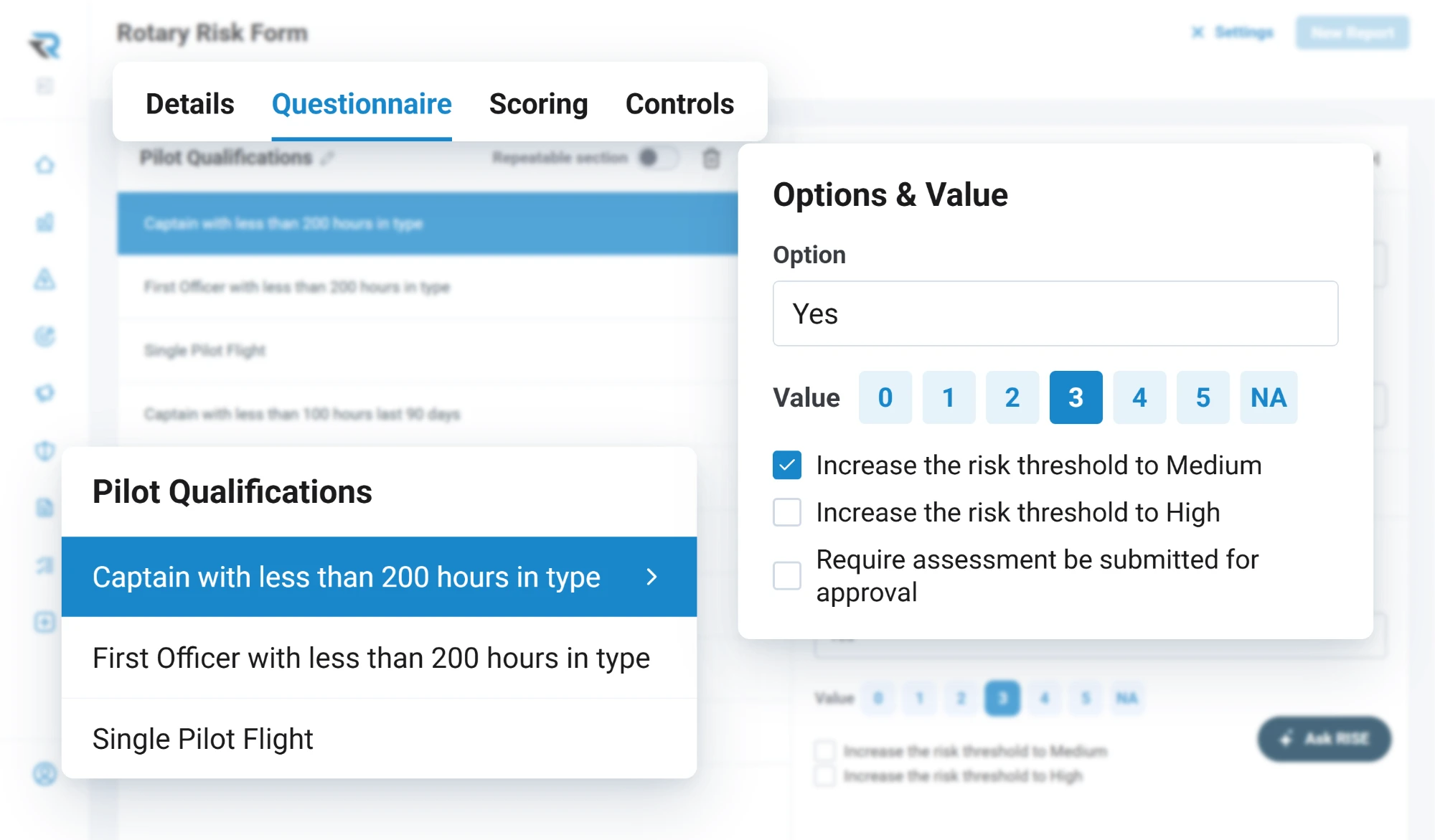
The form is yours: your questions, your point values, and your own line for what counts as elevated. Above it, mitigation stops being optional, and approval can be held until departure rather than at submission, which is the point at which anybody actually knows whether the mitigation happened.
Scheduling
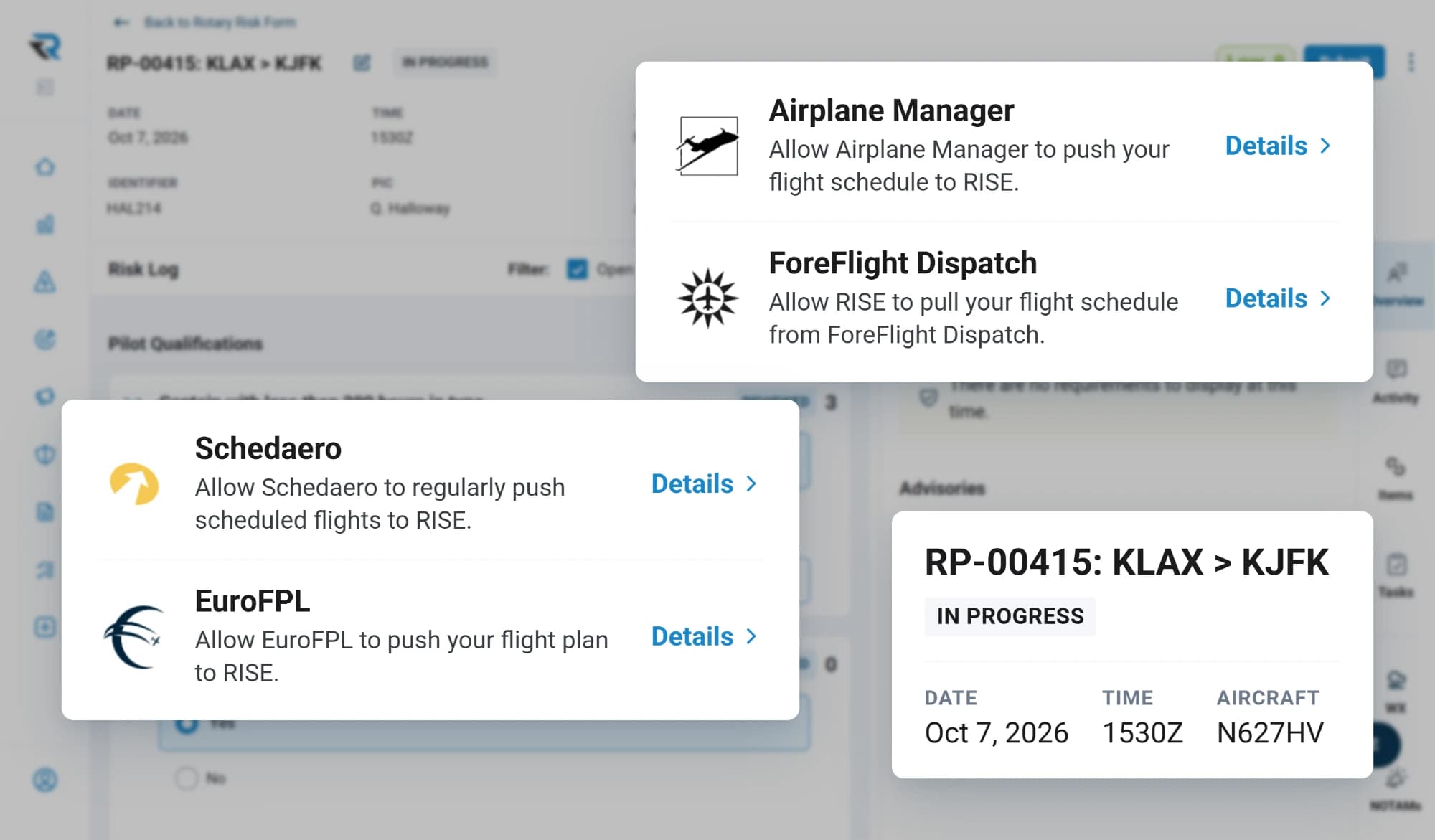
Connect ForeFlight, Schedaero, Airplane Manager or EuroFPL and scheduled operations come across on their own, each one with the right assessment already attached, because you set which form belongs to which aircraft once. Nobody has to remember to raise it, which is the step that gets skipped on the day everything else goes wrong.
Those four are the ones customers asked for. Tell us what you schedule in and we will build the connection to it.
AI analysis
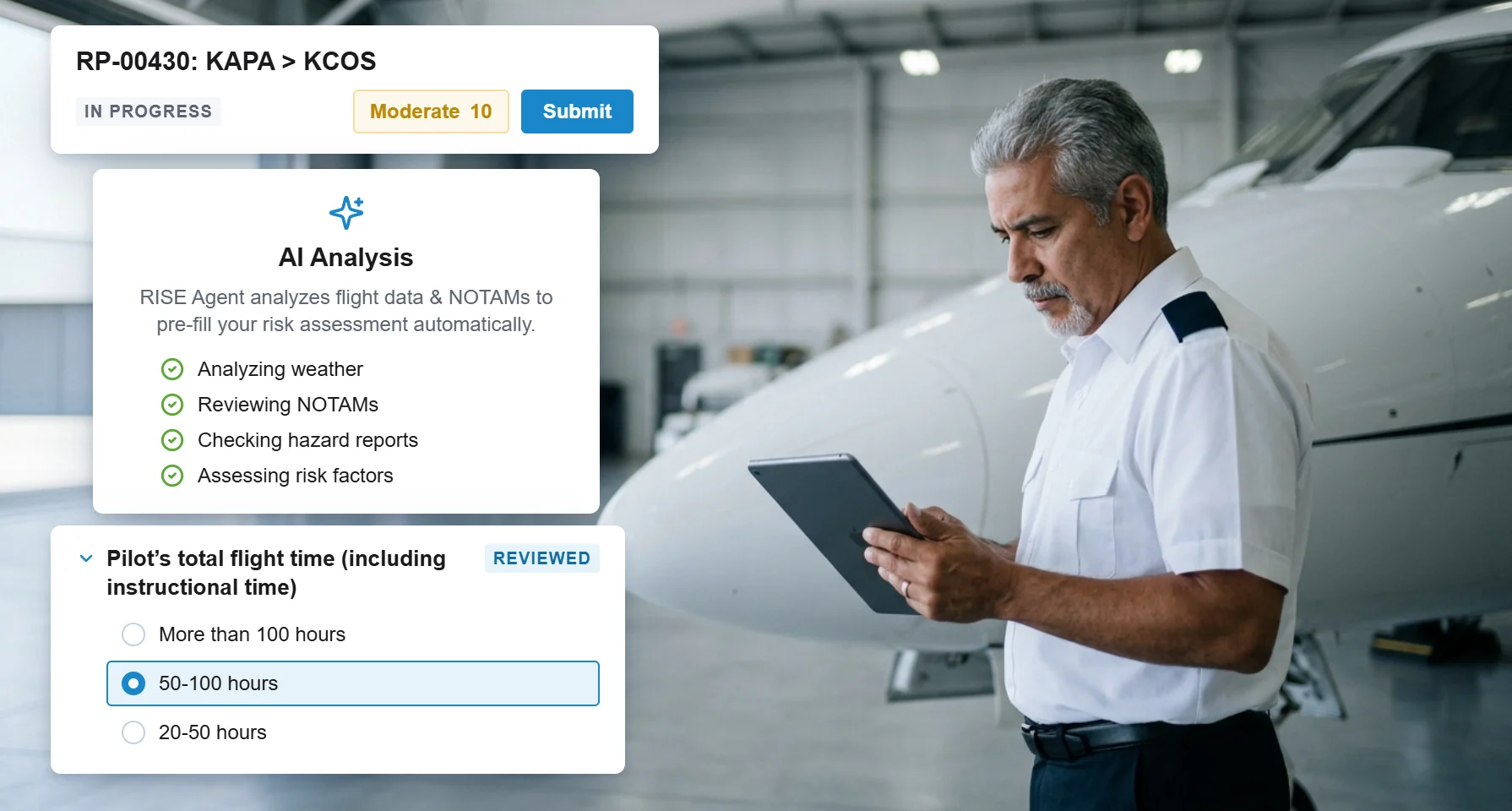
Every form in RISE is yours to change, which is exactly what made filling one in for you impossible for years: we could not answer a question when we had no idea what the question had become.
RISE now takes the trip from your scheduling software, pulls the weather and the NOTAMs for both ends, reads your form as it stands today, and answers what the data genuinely answers. What the crew gets is a preliminary score and a written summary. What they still get is the decision, because nothing is submitted until a person has been through it.
Confidential reporting
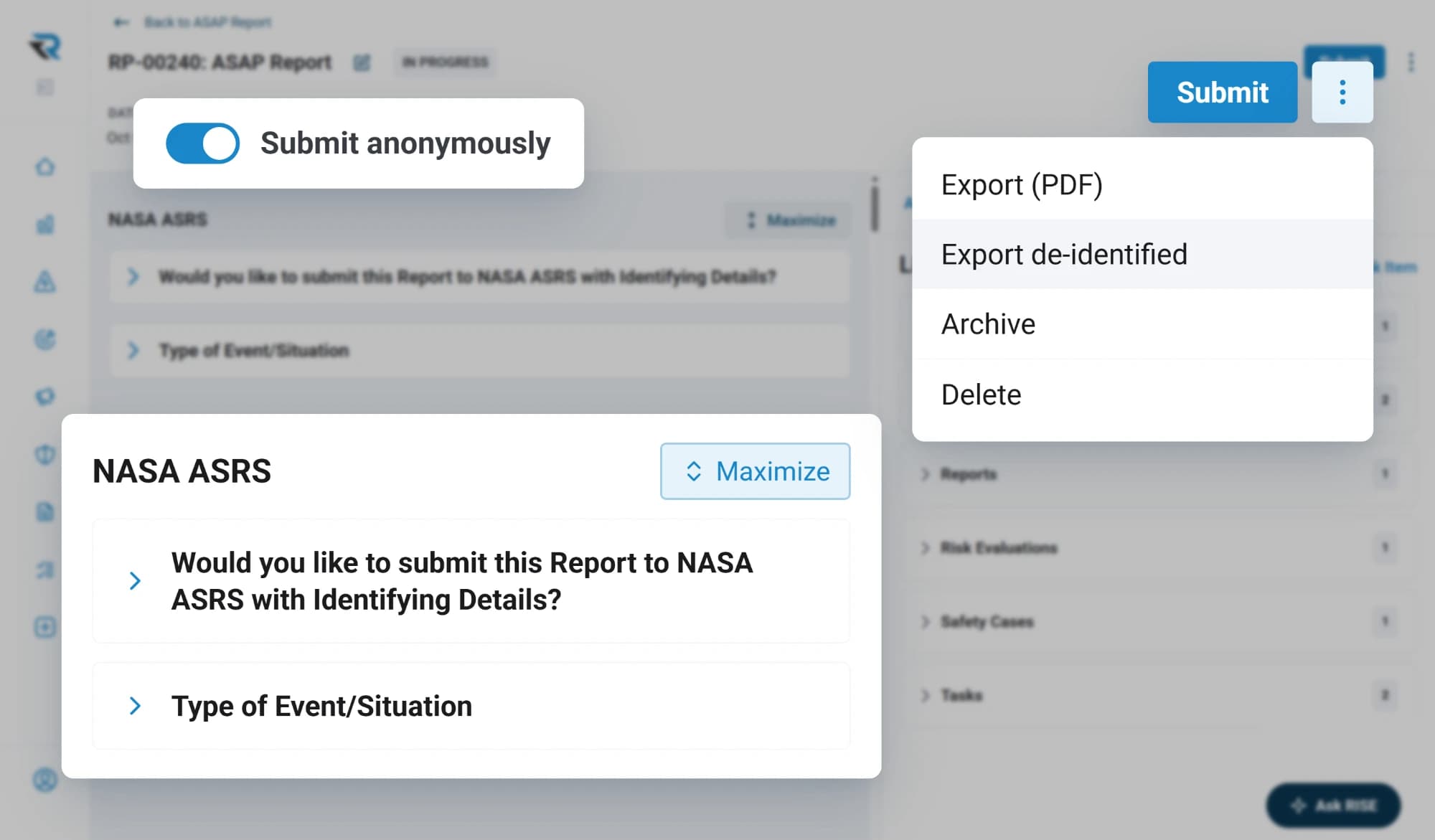
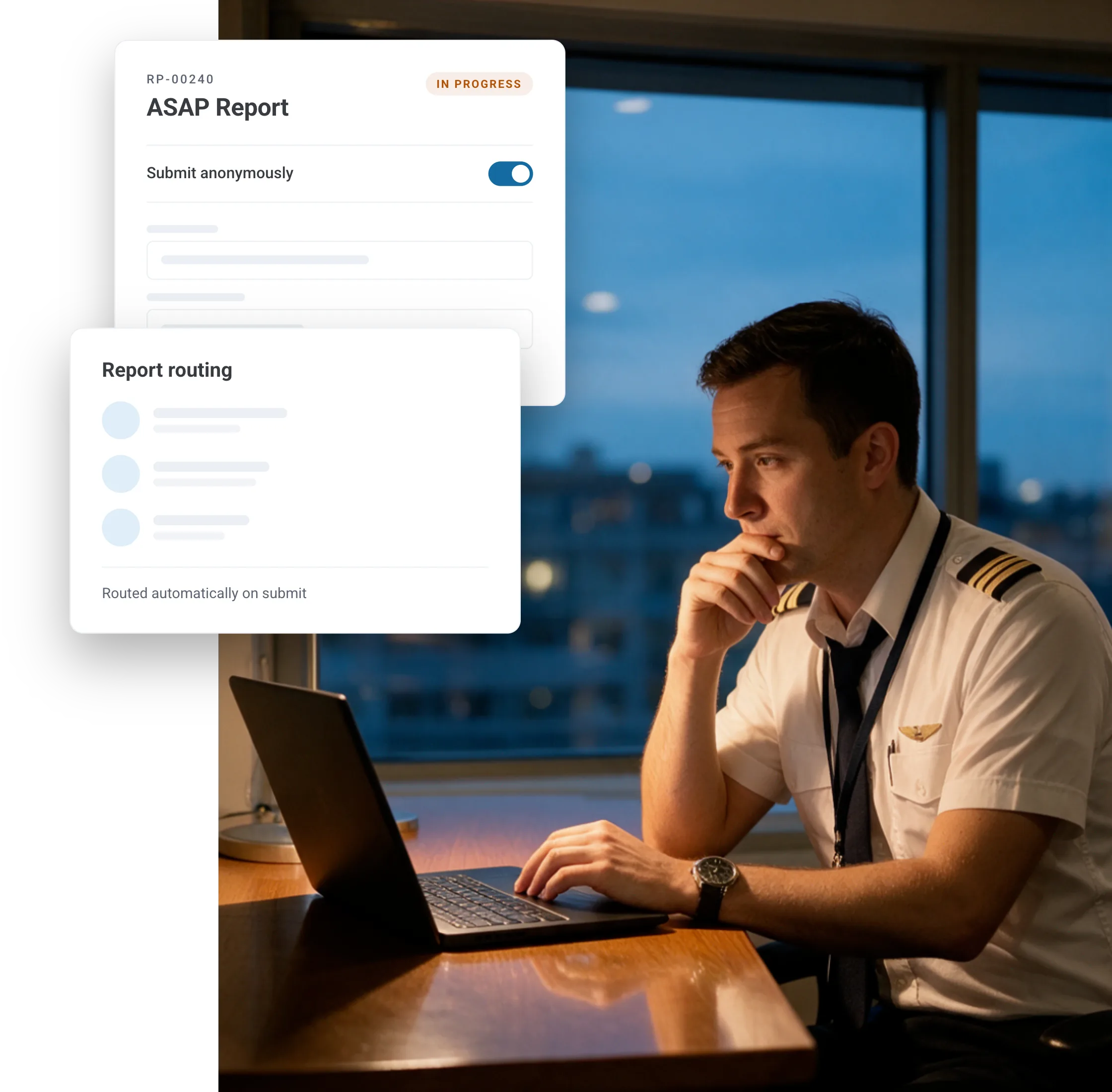
An ASAP report template ships with the product, with its NASA ASRS section where it belongs. Any form can be opened for anonymous submission, and a finished report can be exported de-identified, so what circulates is what happened rather than who it happened to.
Templates
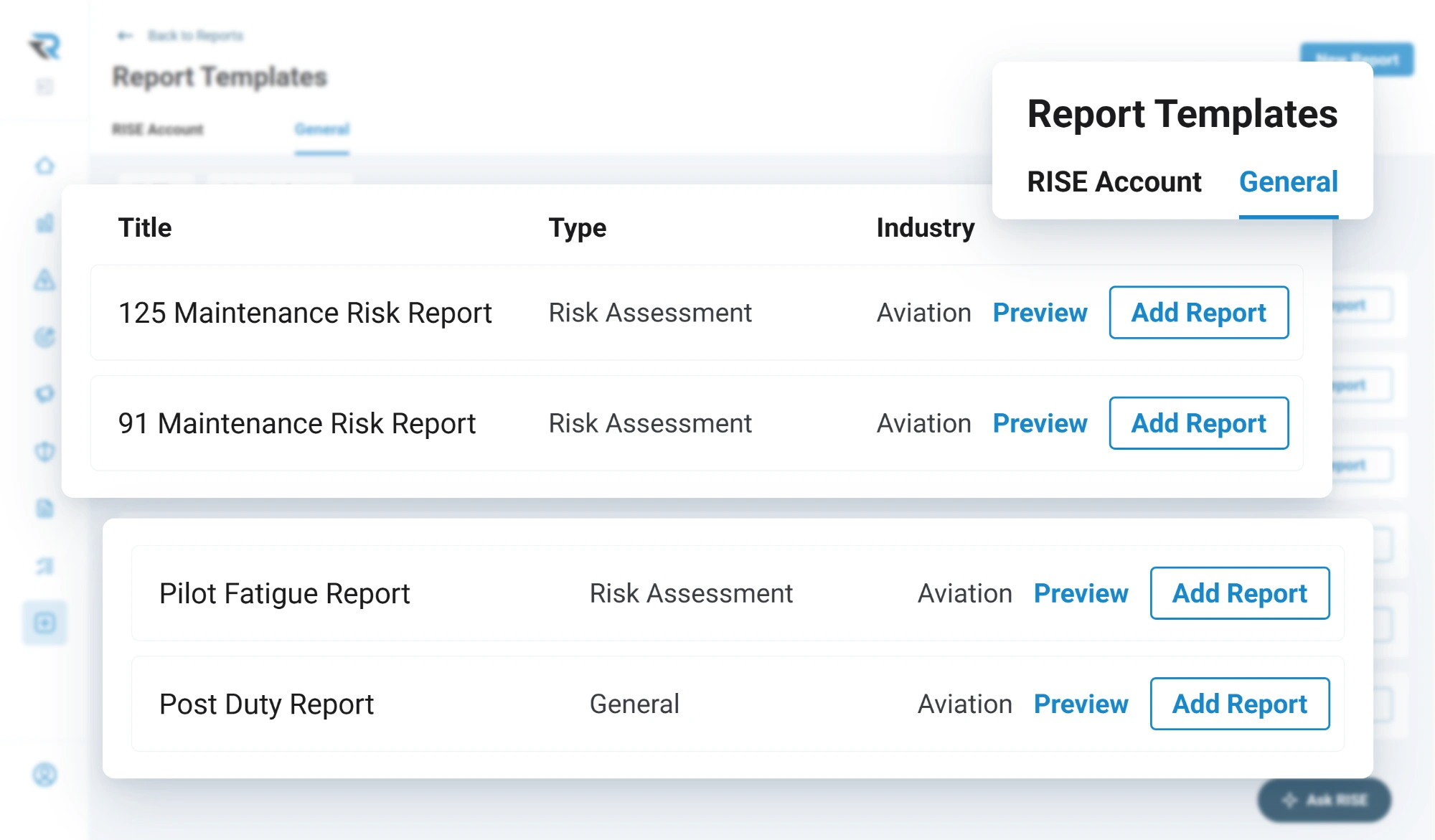
Post-duty and fatigue reporting, IMSAFE, maintenance under Part 91 and Part 125, flight training, airport safety, IS-BAO. They arrive with the account rather than being something you build in the first month, and they are yours to change once they are there.
A free account with the ASAP report form in it. Add your team, change the form to suit your operation, and start collecting reports. No cost, and nothing to change if you ever want the rest of the platform.
Operations
Eight kinds of flying operation, each with its own pages, examples and language, with what each authority calls that work underneath. Operators run on RISE under the FAA, EASA, Transport Canada and CASA, and what matters here is the operation rather than the certificate.
14 CFR Part 5
§ 5.9, commuter and on-demand
States that any person authorized to conduct operations under part 135, or holding a Letter of Authorization issued under § 91.147, before May 28, 2024, must develop and implement an SMS meeting the requirements of the part, and submit a declaration of compliance to the FAA, no later than May 28, 2027.
§ 5.1, applicability
Titled Applicability, and it lists six categories. They include certificate holders under part 119 authorizing operations under part 121 or part 135, persons holding or applying for a Letter of Authorization under § 91.147, and several categories of type and production certificate holders under part 21.
Where a particular operation sits depends on facts about that operation, so it is a question for the operator, their advisors and the FAA. RISE is where the program itself lives, organized the way the rule organizes an SMS. If that date is one your operation is working toward, the earlier we talk the more of the time between now and then is still usable.
Quoted from the regulation, read on October 11, 2026. Verify any requirement against the current text of Part 5, and § 5.1 for applicability as written.
Frameworks
RISE is built so the evidence lines up with whichever framework you work under, and the operators using it answer to several different authorities around the world. Which of these applies to your operation is a conversation worth having properly, rather than a question a website should answer.
ICAO Annex 19
Safety Management, the international standard
Read the source
EASA
Safety management in the European Union
Read the source
Transport Canada
Civil aviation safety management
Read the source
CASA
Civil Aviation Safety Authority, Australia
Read the source
14 CFR Part 5
Safety Management Systems
Read the source
IS-BAO
International Standard for Business Aircraft Operations
Read the source
ARGUS
Operator rating and audit
Read the source
Wyvern
Operator standard and audit
Read the source
Links go to the primary source. Verify any requirement against the current text of the regulation or standard.
Case studies
A repair station, a charter operator and a flight department, in their own words.
Resources
Practical documents you can use whether or not you ever talk to us.
A guided walkthrough of how RISE handles reporting, evaluation, resolution and insight, with time to talk about how your own operation runs today.