· 7 min read
Near Miss Reporting Policy for Construction: What Goes In It
By Michael Sidler, Founder, RISE

Picture the usual near miss policy: a one-page sheet with a definition, a form number and a request for "all near misses." It says nothing about what happens next, the part reporters watch.
A near miss reporting policy that holds up in construction covers seven things: what counts as a near miss on your jobs, who reports (subs included), how and when to report from the field, what to do first if the danger is still there, who reviews reports and how fast, how fixes get owned and closed, and how the reporter and the crew hear back. Write the last three with as much care as the first four.
What counts as a near miss on your jobs?
A near miss is an event where nobody got hurt and nothing got damaged, but a small change would have meant otherwise. A 2016 ASSP study of construction near-hit programs describes it as an incident that could have caused injury or damage "given a slight shift in time or position." That phrase does more work in a policy than a paragraph of legal-sounding definition.
Then make it concrete with examples from your own work. A bundle of rebar that slipped the choker and landed where a laborer stood a minute earlier. A trench wall that sloughed in while the crew was at lunch. An excavator swing that came inside the barricade. A cord-and-plug saw that tripped the GFCI twice and went back in the gang box anyway. Crews recognize their own week faster than they recognize a definition.
Add one line that saves a lot of arguing: when in doubt, report it. Whether it was a near miss, a hazard or a first-aid case is the reviewer's call. A carpenter standing in the mud should not have to classify anything.
Who reports, and does that include subs?
Everyone on site reports, and the policy should say so by name: your crews, every subcontractor's crews, and anyone else working inside the fence. On a general contractor's job, most of the hands belong to someone else. A policy that reads like a page from your employee handbook misses the people most likely to see the load swing over the drywall delivery.
The same section carries the promise that makes people use it: no discipline for reporting a near miss, including one you caused. The 2016 study lists fear of retaliation among the reasons construction has been slower to take up near-hit reporting, along with the belief that more reports make a project look less safe. Write the opposite into the policy, and extend it upward: a superintendent whose site turns in a lot of near misses is doing the job, and nobody gets called into the office over the count.
Offer a way to report without a name, too. Some people will never sign a report about their own foreman. An anonymous report you can act on beats a known hazard nobody mentions.
How and when does a report get made from the field?
Report before the end of the shift, through whichever route is closest. A policy that wants a form in the trailer by nine the next morning collects reports from the people who walk past the trailer.
Give crews two routes. One is telling the foreman or superintendent face to face. The other is a written report anyone can make, signed or not. A QR code on the gate and the trailer door that opens a short form in a phone browser works for sub crews who will never get a login. Keep a stack of paper forms in the gang box as the fallback, and have the super enter them the same day.
Keep the form short: where, when, what happened, what could have happened, what was done on the spot, and a photo if it helps. Our free hazard report form is a reasonable model; it exports to PDF as a finished report.
Above all of this, put one line in bold: if the hazard is still there, stop the work and make it safe first. The report can wait twenty minutes. The study's model says the same for high-severity near-hits.
Who picks it up, and how fast?
Every site needs a named reviewer, usually the superintendent or the site safety lead, and a named backup for the weeks that person is off. "The safety department" is a mailbox, not a reviewer.
Set a clock in the policy. A reasonable one: every report reviewed within one working day, and anything that could have been serious goes to the safety director the same day. The reviewer decides what the report is and what happens next: fixed on the spot and closed, a corrective action, or a fuller look at why it happened. Serious potential gets the fuller look even when the outcome was nothing, because the outcome was luck.
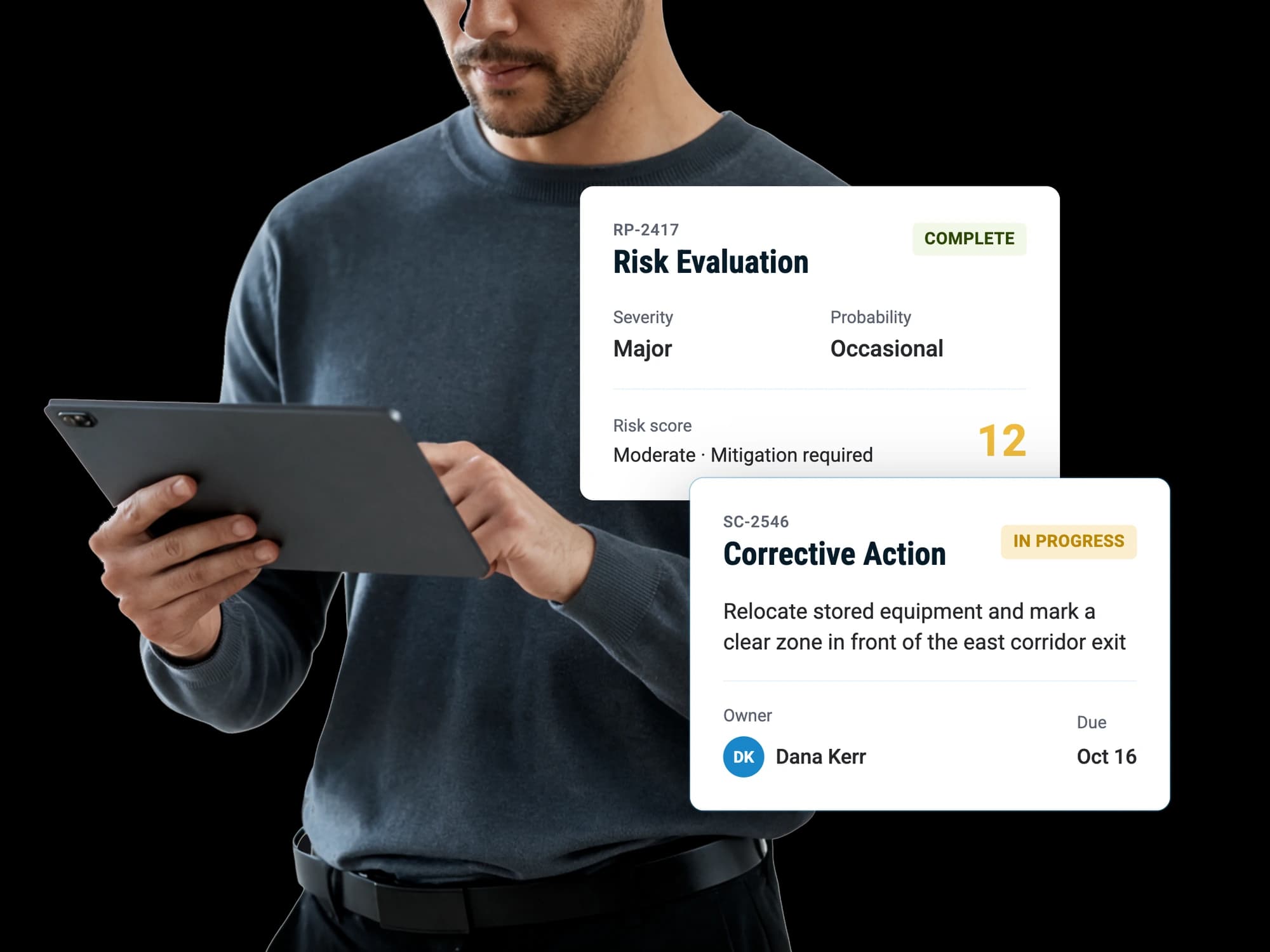
Every corrective action gets one owner, a due date and someone who checks the fix before it is closed. An action assigned to "the electrical sub" belongs to nobody. Write a person's name, and when the work is in a sub's scope, name their foreman.
How does the reporter hear back?
This is the section most policies leave out, and it decides whether you get a second report. Commit to two kinds of feedback in writing.
First, the reporter hears what was done, from a person, within a set number of days. When the report was anonymous, the feedback goes to the crew instead. Second, the rest of the site hears about it. In the 2016 study, near-hits and their fixes were shared with all site personnel as soon as possible, at the next day's toolbox talk for example, and sites with higher near-hit reporting rates had fewer recordable injuries. That is a correlation from one program, but it points the right way.
The cheapest version takes thirty seconds at the tailgate meeting: "Somebody flagged the swing radius on the mini-ex at the parking deck. We moved the barricade and put a spotter on it. Thanks." Every hand on site learns that reports go somewhere.
How do you keep one policy working across several sites?
Use one policy, one definition and one form for every job. Let each site add its own examples and post its own reviewer's name, and keep the fields the same so you can compare jobs side by side.
Then look across sites every month. Which job reported nothing? A site with zero near misses in a month is rarely the safest one. It is usually the quietest. Which kinds repeat? Three dropped-object near misses on three jobs is a company problem, and one fix can go to every superintendent at once.
Leave quotas and prizes off the count. The study's sites ran with no incentives for the quantity or quality of reports, and a quota buys you reports written to hit the number. Recognize the useful report and the closed fix instead.
Where to start this month
- Pull your current policy and check it against the seven parts above. Most gaps sit in review, follow-up and feedback.
- Name a reviewer and a backup for every active job, and post the names on the trailer door.
- Rewrite the no-discipline line in plain words and read it out at the next toolbox talk on each site, subs included.
- Take last month's near misses and tell each crew what happened to them. If there were none, that is your first finding.
RISE handles the reporting end of this. Crews and subs can file a near miss from a phone browser through a QR code with no login, anonymously when you switch that on for the form, and the report goes to the reviewers you set for that form, by person or group. From the report, an Administrator assigns a task to one named person with a due date and priority. To see it set up for your jobs, book a demo.
Sources
Questions people ask
Is a near miss the same as a hazard report?
They overlap, and the policy should send both through the same door. A hazard is a condition that could hurt someone, like an uncovered floor opening; a near miss is an event where something almost did. Crews should not have to tell the two apart before reporting. The reviewer sorts that out.
Should near miss reports be anonymous?
Offer anonymous reporting as an option and keep named reporting as the normal route. Named reports let you ask follow-up questions and thank the person; anonymous ones catch what people will not put their name to, like a foreman cutting corners. A run of anonymous reports from one site tells you something about that site.
Should we reward crews for reporting near misses?
Reward what the report led to, not the number of reports. A gift card for the most near misses gets you a stack of thin reports and a few invented ones. A thank-you at the toolbox talk, by name if the reporter is comfortable with that, and a fix the crew can see do more.
How many near misses should a construction site report?
The useful number is the trend on each site, not a target. Watch for sites that drop to zero, kinds of near misses that keep coming back, and whether reports rise when a new phase like steel erection starts. A rise after crews see reports getting acted on is usually a good sign.
Do subcontractors follow our near miss policy or their own?
On your site, ask them to follow yours, and say so in your subcontract safety requirements and at site orientation. Their company may have its own policy as well, which is fine as long as near misses on your job also reach your reviewer. Agree up front whose foreman owns fixes in their scope of work.
Who should own the near miss policy at a small contractor?
The person who runs safety day to day owns the document, and the owner or a senior manager signs it. The signature matters because the no-discipline promise has to come from someone who can keep it. Review the policy once a year and after any serious incident.