Last updated · 7 min read
The Real Cost of Safety in Construction: One Year of Prevention vs. One Bad Day
By Michael Sidler, Founder, RISE
This article explains published regulations and is not legal or compliance advice. See the linked sources.
Verify against the current regulation at the primary source.

"How do I justify spending $300,000 a year on safety when nobody has been seriously hurt in years?" Owners and operations leaders ask some version of that every budget season, usually while looking at the safety manager's salary.
You justify it by pricing the alternative. One fatal fall costs a contractor roughly $11.7 million before anyone files a lawsuit. That is more than 39 years of a full safety program for a 50-person firm. Add a jury verdict like the $68.5 million award in Philadelphia in 2024, and one bad day costs more than 267 years of prevention. And the money is the smaller half of the argument.
Why does safety feel like overhead?
Because you pay for it every week and the payoff never shows up on a report. The toolbox talk eats the first fifteen minutes of the shift. The pre-task check holds the pick while somebody hunts down the lift plan. The safety manager sits on the overhead line next to the trailer rental, and the software invoice lands the same month a bid margin got squeezed.
What all of that buys is a fall that did not happen. Nobody writes that up. There is no line on the job cost report for "guardrail held."
So the feeling is fair. It is also the wrong comparison. The honest one puts a year of prevention next to the day prevention fails.
What does real safety management include?
It includes a person who owns it and a loop that runs every week: hazards get captured, risk gets assessed, controls go in, and every corrective action gets closed by a named person. A program that lives in a three-ring binder on the plan table has the paperwork without the loop. It looks fine until the day somebody has to prove it worked.
For a typical 50-person contractor, we priced that loop at about $300,000 a year. The two biggest pieces are a full-time safety manager at $110,000 in salary and benefits, and about $50,000 of crew time: 30 minutes per worker, per week, for hazard reports, JHAs and toolbox talks. The rest covers safety management software, added schedule time for permits and pre-task checks, training and certifications, fall protection and PPE upgrades, equipment to close corrective actions, and third-party audits and inspections. These are illustrative annual estimates. Your crew size and work mix will move them.
The crew-time line is the one people resent, and it does the most work. A hazard report from a framing sub's foreman beats a new policy page every time, as long as it is easy to file and somebody answers it. On a site with six trades, that means reporting without a login for people who will never get an account on your system. The other half is what happens next: someone scores the risk, picks a control and chases the fix until it is closed. If you want a starting point, our free hazard report form lets anyone write up a hazard in the browser, scores severity against probability, and prints a finished report.
One year of prevention against one bad day
Want it on the screen at your next owner meeting? Share it from the infographic page.
The numbers on it, for anyone who wants them in one place:
- One year of real safety for a 50-person contractor: $300,000
- One fatal fall, before any lawsuit: $11,736,542, more than 39 years of the program
- The same fall plus the 2024 Philadelphia verdict: $80,236,542, more than 267 years of the program
- National Safety Council cost per work death, 2024: $1,540,000
- National Safety Council cost per medically consulted injury, 2024: $48,000
- OSHA maximum per willful violation for 2026: $165,514, from the penalty memo
The investment figures and every item marked (est.) on the infographic are illustrative. The NSC, OSHA and verdict figures come from the sources linked in this post.
What does one fatal fall cost a contractor?
About $11.7 million before a lawsuit, built from six pieces. Two are published. Four are estimates, and they are the big ones.
Start with the published floor. The National Safety Council puts the cost per death at $1,540,000 in 2024, counting wage losses, medical and administrative expenses, and employer costs. That is a national average, the starting point rather than the bill.
Then OSHA. As written in OSHA's 2026 penalty memo, "2025 penalty amounts remain in effect for 2026," and the memo's table lists a maximum of "$165,514 per violation" for willful and repeat violations and "$16,550 per violation" for serious ones. Three willful citations at that maximum come to $496,542. It is the smallest line on the bill.
The estimates are where it grows. Shutting the project down, the investigation and the delays that follow: about $2 million. Legal defense: about $1.5 million. Higher insurance premiums and a worse EMR for three years: about $1.2 million. The one that lasts longest is about $5 million in lost bids and contracts, because owners and GCs prequalify on safety record and they have long memories.
Then the jury. In June 2024 a Philadelphia jury awarded $68.5 million to the estate of a 38-year-old construction worker who died in December 2021 after falling from a fifth-floor balcony. The complaint alleged that a temporary wooden guardrail gave way. The jury spread the fault across several companies on the project, and a judge later reaffirmed the verdict. Add that award to the rest and one bad day comes to $80,236,542.
None of this is a rare edge case. The Bureau of Labor Statistics counted 1,034 workplace deaths in private-sector construction in 2024, and over one-third of them, 389, were due to falls, slips and trips.
If your CFO wants a return figure, OSHA's business case page cites a 2005 Liberty Mutual survey in which over 60% of chief financial officers said each $1 invested in injury prevention returns $2 or more. That is a modest claim. The fall math does not need it.
Who goes home tonight?
The money is real, and it is still the smaller half. The worker in Philadelphia left a wife and a young son. No verdict gives them back what they lost.
When the program works, nothing happens, and nothing happening looks like this. A laborer leans on the temporary rail at a third-floor slab edge, feels one post give, and pulls up the hazard form from the QR code zip-tied to the stair tower to report it. The safety manager reads it before lunch, rates it high and assigns the fix to the framing foreman, due tomorrow. The rail gets re-anchored. Someone walks it, shakes it, photographs it and closes the corrective action.
Nobody notices. There is no memo, no meeting, no story at the bar. The crew finishes the deck Friday and drives home. That is what the $300,000 bought. The checks and balances worked, and someone's dad, daughter or best friend went home tonight.
Where to start this month
Swap our 50-person example for your own crew, payroll and work. Our free construction safety ROI calculator runs the same comparison with your numbers.
Then, before the month is out:
- Walk the fall exposures on every active site: leading edges, floor openings, balconies, temporary rails. Note each one that depends on somebody remembering.
- Pull your open corrective actions and count how many have a named owner and a due date. One without both is a wish.
- Make it easy for every trade to report a hazard or a near miss, and answer each one within a day. A clear near miss policy tells reporters what happens next.
- Build next week's toolbox talk from this month's site reports, not from a generic topic list.
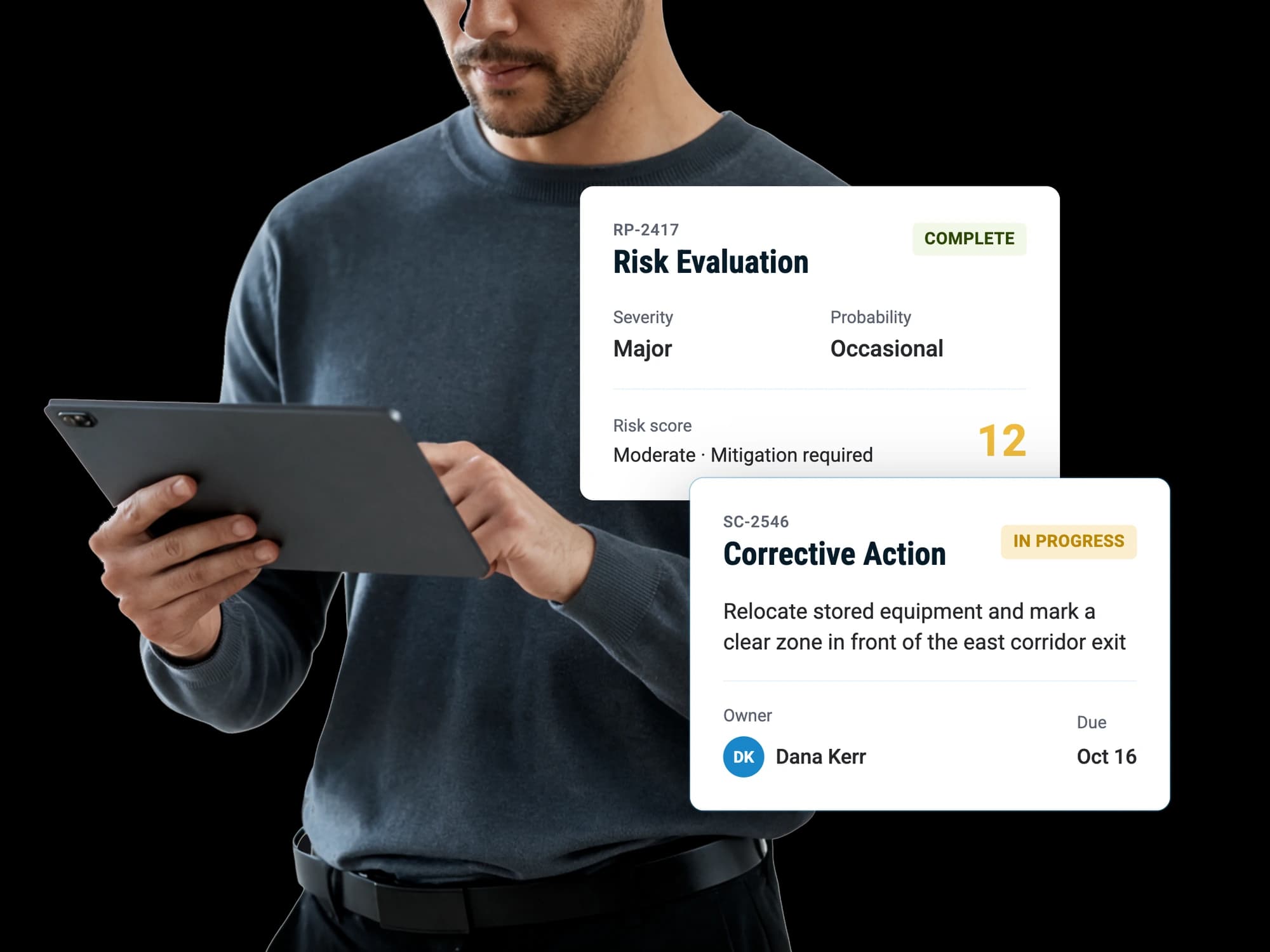
RISE records hazard reports from a phone browser or a QR code posted at the site gate, scores risk on a severity and probability matrix, and tracks each corrective action to a named owner, a due date and a verified close. If you want that loop running on every job site, book a demo.
Sources
- OSHA: 2026 Annual Adjustments to OSHA Civil Penalties (memo, May 21, 2026)
- National Safety Council Injury Facts: Work Injury Costs
- BLS TED: National Safety Stand-Down highlights fall hazards in construction
- Philadelphia Inquirer: Philadelphia jury awards $68.5 million after construction site fall
- ENR: Court Upholds $68M Jury Award Over 2021 Fatal Fall in Philadelphia
- OSHA: Business Case for Safety and Health
Questions people ask
How much does a workplace fatality cost a construction company?
In our illustrative example, one fatal fall costs a 50-person contractor about $11.7 million before any lawsuit. That covers lost bids, shutdown and delays, legal defense, higher insurance and EMR, OSHA penalties, and the National Safety Council's $1,540,000 average economic cost per work death. A jury verdict can add far more, as the $68.5 million Philadelphia award did in 2024.
What is the ROI of a construction safety program?
The clearest return is the loss you avoid: in our example, one fatal fall costs more than 39 years of a $300,000 program. For a published figure, OSHA's business case page cites a 2005 Liberty Mutual survey in which over 60% of CFOs said each $1 invested in injury prevention returns $2 or more.
What are OSHA's maximum penalties in 2026?
As written in OSHA's 2026 penalty memo, the maximum is "$165,514 per violation" for willful and repeat violations and "$16,550 per violation" for serious ones. The memo also says "2025 penalty amounts remain in effect for 2026." How penalties would be figured on your own sites is a conversation for your OSHA area office.
How much does a medically consulted work injury cost?
The National Safety Council put the cost per injury at $48,000 for each medically consulted work injury in 2024. That figure counts wage losses, medical and administrative expenses, and employer costs. It is a national average, so a serious injury on your site can run far higher once schedule, insurance and reputation join the bill.
What does a construction safety program include?
A working construction safety program includes a person who owns it, usually a full-time safety manager, and a weekly loop: hazards reported by every trade, risk assessed, controls put in place and every corrective action closed by a named owner. Training, fall protection, pre-task planning and periodic audits keep that loop honest. A shelf of forms does not.