Last updated · 8 min read
Aviation Hazard Register: What Goes In and How to Keep It Current
By Michael Sidler, Founder, RISE
This article explains published regulations and is not legal or compliance advice. See the linked sources.
Verify against the current regulation at the primary source.

The FAA's SMS final rule walks through a small air tour company that "has two helicopters and four pilots," and when a pilot reports an unmarked power line across a canyon, everything that follows, from the research to the risk call to the new route, lands in one place: "All this information is placed into the notebook."
That notebook is a hazard register. An aviation hazard register is a running list of the hazards your operation actually faces, one line per hazard, each carrying its risk assessment, its controls, an owner and a date to look at it again. It stays current when every new report, risk assessment and closed corrective action either adds a line or changes one.
Why isn't the report log enough?
Reports describe events, which our guide to good hazard reports covers in more detail. The register describes conditions. A report says the ramp at the FBO was dark again on Tuesday night. The hazard is the unlit ramp at that field, and it stays a hazard until someone fixes the lighting or changes how you operate there.
Plenty of small operators have a stack of reports and no register. The stack grows, nobody can say which risks are open, and the third report about the same dark ramp gets read as if it were the first. Twelve reports about one problem belong on one line, with twelve reports linked to it. That is how a pattern becomes visible, which our guide to turning reports into insights covers in more detail. If the same hazard keeps coming back after you thought it was fixed, our post on repeat hazards digs into why.
Hazards also arrive from outside the reporting form: a post-flight debrief, an internal audit finding, a discrepancy that keeps showing up in the logbook, a conversation at the fuel truck. The register is where all of them land once someone decides they describe a hazard.
What goes on each line of an aviation hazard register?
Keep it short enough to fill in during a busy week. For each hazard:
- A hazard statement and where it shows up (aircraft, base, route, task or shop area)
- The reports, audit findings or events that raised it
- Initial risk, scored on severity and probability
- Controls, each with an owner and a due date
- Residual risk, and who accepted it and when
- The hazard's owner, next review date and status
The hazard statement does most of the work, and it is where most registers go soft. "Weather" is not a hazard statement. Neither is "pilot error." Try "Afternoon convective buildups over the ridge on the practice area route, with students out on solo cross-countries" at a flight school, or "Torque wrenches back from calibration without updated tags, mixed in with in-service tools in the hangar crib" at a repair station. A good statement names a condition someone could walk up to and change.
Score every hazard on the same severity and probability matrix you use everywhere else, and agree where low, medium and high begin before the first argument about a borderline score. In RISE, risk assessment forms carry low, medium and high thresholds, and a score above the chosen threshold can require mitigation or approval before submission or before work starts. Our free risk tolerance quiz works out where those thresholds belong for your operation and gives you two numbers to set on your own forms.
Status needs three values at most: open, controlled and retired. Retired lines stay on the register with their history, because hazards have a habit of coming back.
How do you keep it current as reports keep coming in?
Give the register three triggers and check them on a schedule. A register reviewed once a year is a history book.
The FAA's example frames the starting point plainly: "The report of the hazard is the start of the safety risk management process under § 5.51(d)," as written in the final rule. In practice, the three triggers look like this.
A new report arrives. Someone reads it within a few days and makes a call: new hazard, existing hazard, or not a safety issue. A new hazard gets a line and a risk assessment. An existing one gets the report linked to it and a pointed question: does this report mean the controls are not working? If the answer is yes, the risk gets scored again.
A corrective action closes. The control moves onto the hazard's line, the residual risk gets rescored, and someone checks that the fix works before the hazard moves to controlled. A revised procedure nobody was briefed on is a control on paper.
The review date comes up. Every hazard gets one when its risk is accepted. High residual risk earns a short interval. A stable, well-controlled hazard can go longer. The FAA's air tour operator watches its route deviation "by tracking the flight path or auditing the new procedures," according to the final rule, which is the same idea at two-helicopter scale.
Planned changes get their own pass through management of change, and the register is part of the process. A new aircraft type, a new base, a charter customer flying into an unfamiliar ramp, a new maintenance contract at the repair station: each one gets its potential hazards evaluated before it goes live, not after. Walk the existing lines and ask which ones the change touches, then write down the hazards it brings that nobody has logged yet. Our management of change program service builds that process for your operation so the risk assessment is part of every new aircraft, base, person or procedure.
Who owns the register at a small operator?
The safety manager holds the pen. That does not make the safety manager the owner of every hazard. Each hazard needs an owner who can change the condition: the director of operations for a route or scheduling hazard, the director of maintenance or chief inspector for a tooling problem in the shop, the chief instructor for a training-area hazard. Someone who cannot directly change the condition is only pretending the scenario is being handled.
The accountable executive's part is acceptance. When residual risk stays high, the decision to keep operating with it belongs to someone with the authority to spend money or stop flying, and the evaluation register should show who made that call and on what date.
Then hold a standing review. Thirty minutes a month with the safety manager, the DO and the DOM or chief inspector: open hazards first, overdue actions second, anything rescored since last time third. At a single-aircraft flight department, that might be two people at the hangar office desk. It still counts.
Where should a small operator start this month?
Your register already exists. It is scattered through reports, emails and somebody's memory, and the first job is to gather it.
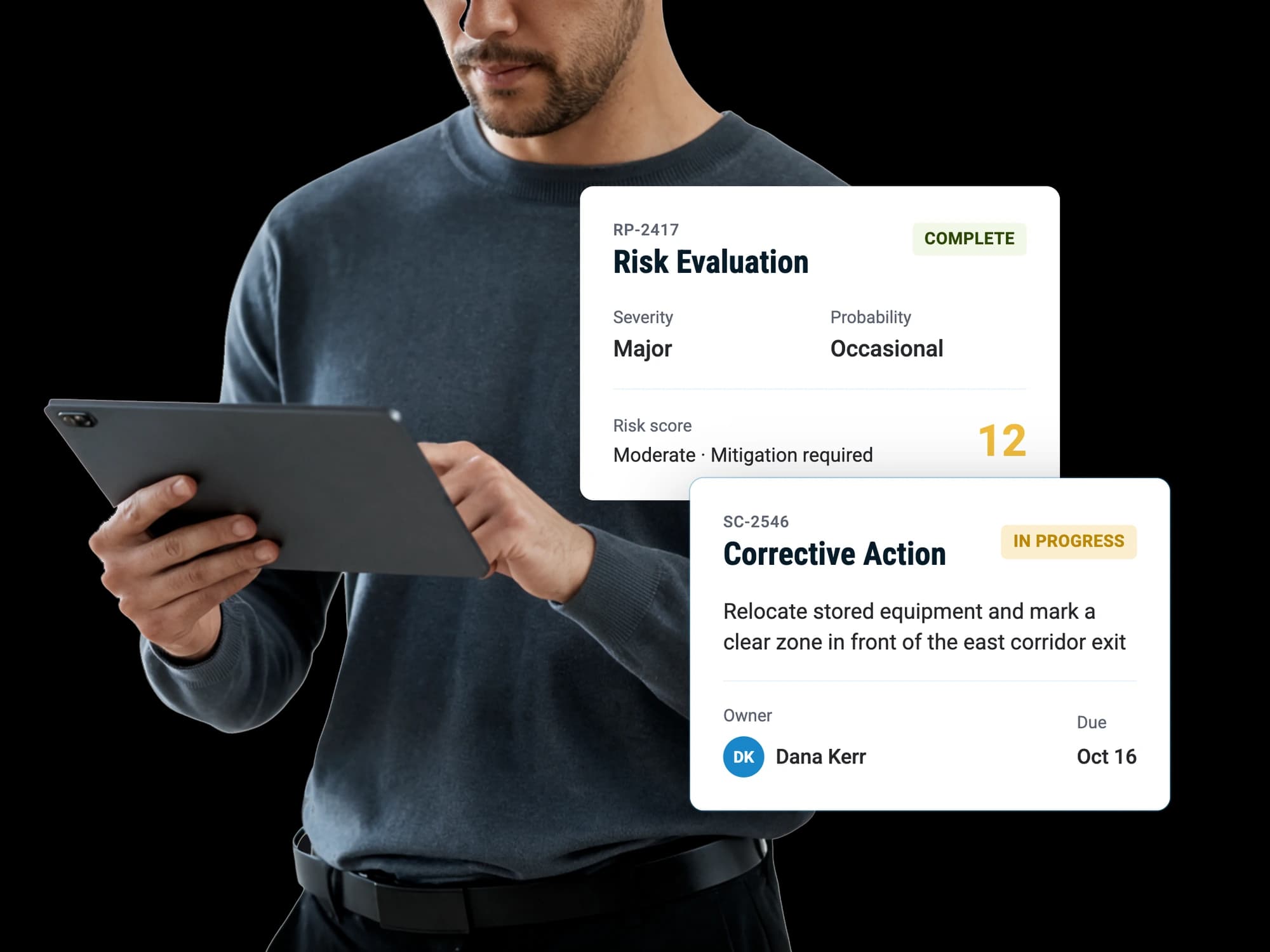
RISE keeps risk evaluations with the hazard register attached, initial and residual risk scored on a risk matrix, and a control library where each control is written once and reused. Safety objectives, with indicators and targets, sit alongside it.
Give every hazard an owner and a review date, put the monthly review on the calendar, and run the first one before the month is out. A rough register that gets reviewed beats a polished one that sits in a folder.
In RISE, a reviewer triages each submitted report as a hazard, near miss, incident, accident or not a safety issue and sets what happens next. The hazard register holds each hazard with its risk evaluations attached and linked to the reports behind them, controls are written once in a control library and reused, and corrective actions sit in the Task Register with one owner, a due date and a link back to their source. An AI assistant, available as a paid add-on, answers questions about those records, such as which hazards still have open tasks. To see it with your own reports, book a demo.
Sources
Questions people ask
Is a hazard register the same as a risk register?
They overlap so much that many operators use the two names for one document. A hazard register is organized around conditions in the operation, with the risk scored against each one, while a risk register sometimes also carries business risks like insurance or staffing. For a flight department or repair station, one list of operational hazards with the risk scored on each line does the job without a second document.
How many hazards should a small operator's register hold?
Enough to cover what your reports, audits and people actually tell you, which at a small operator usually means a few dozen lines. A register with three hundred lines copied from a generic list tends to go unread. A register with four lines usually means reports are not reaching it.
Why keep a hazard on the register once it is controlled?
Because hazards come back: the seasonal ones every year, the tooling ones every time a new technician joins the shop. A retired line with its old reports and controls saves you redoing the analysis when it reappears. It also shows anyone reviewing the program what you found and what you did about it.
Can a spreadsheet work as an aviation hazard register?
A spreadsheet works for a small operator with one person keeping it and a monthly review that actually happens. It gets harder once reports, risk assessments and corrective actions live in separate files and someone has to copy between them, because the links between a hazard and its reports are the first thing to break. Whatever you use, the test is whether you can open one hazard and see every report, score, control and owner behind it.
What is the difference between a hazard and a risk?
A hazard is the condition, and the risk is how bad the outcome could be and how probable it is. The unmarked power line across the canyon is the hazard; flying the tour route through it with no controls is the risk you score. Registers get muddled when they list outcomes such as a wire strike as the hazard, so write the condition first and score the outcome against it.
Who should be able to see the hazard register?
Everyone whose work the hazards touch should be able to see the open ones and what is being done about them. Pilots and technicians report more when they can see a report turn into a line with an owner and a date. Keep reporter names off the version you share widely, especially for confidential reports.