· 6 min read
How Risk Assessments Should Be Used in Daily Operations
By Michael Sidler, Founder, RISE

How risk assessments should be used in daily operations is a practical question that sits at the center of an effective Safety Management System in business aviation. Risk assessments are not paperwork exercises or compliance artifacts. They are decision support tools that help operators identify hazards, evaluate exposure, and apply controls before normal activities create unacceptable risk. When used correctly, risk assessments inform everyday operational decisions rather than reacting to events after they occur.
In daily operations, risk assessments should be used to support planning, authorize work, prioritize mitigations, and confirm that risk controls remain effective over time. This applies across flight operations, maintenance, training, and ground activities. Under FAA 14 CFR Part 5 and aligned with ICAO Annex 19, risk assessments are expected to be embedded into how work is performed, not isolated within the safety office.
When risk assessments become routine inputs to operational decisions, they help organizations shift from reactive safety management to proactive risk control.
What Is a Risk Assessment in a Safety Management System?
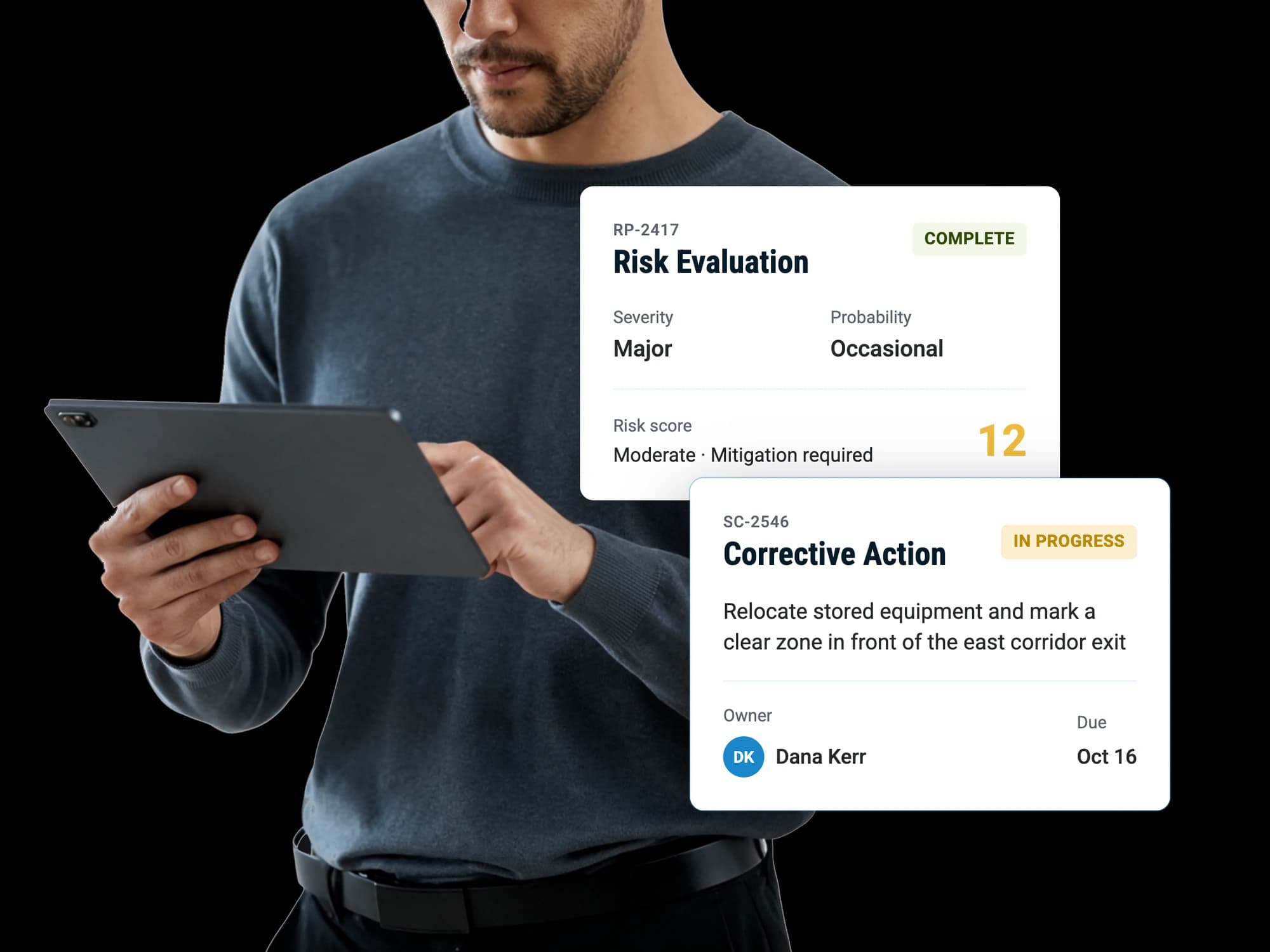
Within a Safety Management System in business aviation, a risk assessment is a structured process used to evaluate the potential consequences and probability of a hazard leading to an unsafe outcome.
It combines two core elements:
-
Severity, or the potential impact if the hazard results in an occurrence
-
Probability, or how often the hazard could reasonably lead to that occurrence
Risk assessments do not predict the future. They provide a disciplined method for evaluating exposure so that decisions are made consistently and based on defined criteria rather than intuition.
Under FAA Part 5, risk assessment is a core component of Safety Risk Management. ICAO Annex 19 uses similar concepts and terminology, emphasizing the need for organizations to identify hazards and assess associated risks as part of normal operations.
Why Risk Assessments Matter in Business Aviation Operations
Business aviation operations are often dynamic, variable, and resource constrained. Unlike large scheduled carriers, business aviation departments may operate with smaller teams, less redundancy, and higher variability in missions, destinations, and operating environments. These characteristics increase the importance of structured risk assessment.
Risk assessments help operators:
-
Make consistent decisions across different crews and shifts
-
Identify elevated risk before a flight, maintenance task, or operational change
-
Allocate limited resources to the areas of greatest exposure
-
Demonstrate risk-based decision making during audits or oversight activities
In this context, risk assessments are not about eliminating risk entirely. They are about understanding risk well enough to manage it within acceptable limits.
When Should Risk Assessments Be Used in Daily Operations?
Risk assessments should be applied at specific decision points where hazards and operational exposure may change. Common examples include:
-
Pre-flight or pre-task planning
-
Maintenance activities that deviate from routine procedures
-
Changes to schedules, staffing, or equipment
-
Introduction of new procedures or training programs
-
Environmental or operational conditions outside normal parameters
Daily use does not mean assessing every minor task. It means applying risk assessment where decisions have safety significance.
Many operators reference this concept in foundational guidance on what a Safety Management System in business aviation is intended to accomplish. Risk assessments translate policy into action at the operational level.
How Risk Assessments Support Daily Operational Decisions
Pre-Flight and Mission Planning
In flight operations, risk assessments are commonly used to evaluate factors such as weather, crew readiness, aircraft status, destination considerations, and operational complexity. When used properly, the assessment highlights elevated risk conditions and prompts appropriate controls such as delaying departure, adding fuel, adjusting crew pairing, or increasing oversight.
The value lies in the discussion and decision making that follows the assessment, not the numerical score itself.
Maintenance and Technical Operations
For Part 145 repair stations and internal maintenance teams, risk assessments support task planning and work authorization. Examples include deferred maintenance, unfamiliar tasks, tooling limitations, or schedule pressure. A structured assessment helps supervisors identify where additional inspections, staffing, or sequencing controls are needed.
This approach aligns with guidance commonly referenced in explanations of SMS requirements for Part 145 repair stations.
Ground and Support Activities
Ground handling, fueling, towing, and training activities also benefit from routine risk assessment. Changes in personnel, equipment, or environment can introduce hazards that are not immediately obvious without a structured review.
How Risk Assessments Differ Across Part 91, 135, and 145 Operations
While the principles are consistent, application varies by operational context.
-
Part 91 operators often use risk assessments to support voluntary SMS programs, focusing on consistency and decision quality rather than regulatory thresholds.
-
Part 135 operators use risk assessments as part of required SMS implementation, with more formal documentation and defined risk acceptance authorities.
-
Part 145 organizations focus on task-based risk assessment tied to maintenance planning, human factors, and quality assurance processes.
Understanding how SMS applies differently to Part 91, Part 135, and Part 145 operators helps organizations tailor risk assessments to their operational realities rather than adopting one-size-fits-all tools.
Common Misunderstandings About Risk Assessments
Several recurring issues reduce the effectiveness of risk assessments in daily operations.
Treating Risk Scores as the Decision
Risk matrices are tools, not answers. When organizations focus solely on whether a score falls into an acceptable range, they miss the intent of the process. The assessment should drive discussion and control selection, not replace judgment.
Using Risk Assessments Only After Events
Risk assessments are preventive tools. Conducting them only after incidents or audit findings turns them into retrospective exercises rather than operational safeguards.
Overusing Risk Assessments
Assessing every task regardless of complexity leads to fatigue and disengagement. Effective programs define when assessments are required and when standard procedures are sufficient.
Disconnect Between Assessment and Action
A risk assessment without documented controls, follow-up, or accountability does not manage risk. The output must link to operational changes or monitoring activities.
What “Good” Looks Like in Daily Use
When risk assessments are used effectively in daily operations, several characteristics are consistently present.
-
Clear criteria define when an assessment is required
-
Front-line personnel understand the purpose and limitations of the tool
-
Assessments trigger meaningful discussion and decision making
-
Risk controls are practical, documented, and assigned to responsible parties
-
Outcomes are monitored to confirm effectiveness over time
This approach aligns with broader guidance found in discussions of the four pillars of SMS explained for business aviation, particularly the link between Safety Risk Management and Safety Assurance.
How Risk Assessments Support Proactive Safety Management
Effective use of risk assessments contributes to identifying trends and systemic issues. When assessments are reviewed collectively, safety managers can identify recurring hazards, common control weaknesses, or operational pressures that elevate risk.
This data supports proactive interventions such as procedure updates, targeted training, or resource adjustments. Over time, this strengthens the organization’s ability to manage risk before events occur.
This concept is closely tied to how SMS helps identify systemic risk patterns, where individual assessments provide insight into broader organizational exposure.
The Role of Technology in Supporting Risk Assessments
Modern SMS platforms can support daily risk assessment use by improving consistency, accessibility, and data integration. Key capabilities include:
-
Standardized assessment criteria aligned with organizational policy
-
Mobile access for operational personnel
-
Automated tracking of risk controls and follow-up actions
-
Aggregated reporting to identify trends across operations
Technology should support the process rather than replace professional judgment. The goal is to reduce administrative burden while preserving the quality of decision making.
Guidance on what to look for in aviation SMS software often emphasizes these supporting functions without changing the fundamental principles of risk assessment.
How Risk Assessments Fit Within Regulatory Expectations
FAA 14 CFR Part 5 requires operators to identify hazards, assess risk, and implement controls appropriate to their operation. ICAO Annex 19 reinforces this expectation by emphasizing risk-based decision making as a core element of safety management.
Regulators and auditors typically look for evidence that risk assessments influence operational decisions rather than existing as standalone documents. This expectation is frequently discussed in explanations of what auditors look for in an SMS program.
A Practical, Sustainable Approach
How risk assessments should be used in daily operations ultimately comes down to integration. Risk assessments should be applied at meaningful decision points, scaled to operational complexity, and linked directly to actions and monitoring.
When embedded into routine planning and supervision, risk assessments help organizations maintain situational awareness, manage variability, and support consistent decision making across the operation. Over time, this approach strengthens safety performance and supports compliance without creating unnecessary administrative burden.
In a Safety Management System in business aviation, risk assessments are most effective when they are treated as practical tools used by the operation, not as forms owned by the safety department.