· 6 min read
How to Turn Hazard Reports into Actionable Insights
By Michael Sidler, Founder, RISE

How to turn hazard reports into actionable insights is a common challenge for operators implementing a Safety Management System in business aviation. Most organizations can collect hazard reports. Far fewer consistently convert those reports into decisions, controls, and measurable safety improvements. When hazard data sits unused, the reporting system becomes an administrative exercise rather than a core safety function.
At its core, a Safety Management System in business aviation is designed to identify hazards, assess risk, and manage that risk through informed action. Hazard reports are the primary input into that process. Turning them into actionable insights requires structure, discipline, and an understanding of how safety data should flow through the SMS, from initial report to management decision.
This article explains how hazard reports are intended to be used, why insight generation matters operationally, and what effective implementation looks like across Part 91, Part 135, Part 145, Part 141, and Part 139 environments.
What does it mean to turn hazard reports into actionable insights?
An actionable insight is a conclusion drawn from hazard data that leads to a specific safety decision or operational change. That change may involve risk controls, procedural updates, training, equipment adjustments, or management attention to an emerging issue.
A hazard report by itself is information. An insight exists only when that information is analyzed, contextualized, and linked to action. In a Safety Management System in business aviation, this typically occurs through the Safety Risk Management and Safety Assurance processes defined under FAA 14 CFR Part 5 and aligned with ICAO Annex 19.
Actionable insights answer practical questions such as:
-
Is this hazard isolated or systemic?
-
Does this trend indicate increasing risk?
-
Are current mitigations effective?
-
Does management need to intervene?
Without this translation step, hazard reporting loses much of its intended value.
How hazard reports are defined within an SMS framework
A hazard report is a formal submission that identifies a condition, practice, or situation with the potential to cause harm. Under Part 5, hazard identification is a foundational element of Safety Risk Management.
Effective hazard reports typically include:
-
A clear description of the condition or event
-
Operational context, such as phase of operation or environment
-
Contributing factors when known
-
Immediate actions taken, if any
The purpose of collecting this information is not to assign blame or document compliance activity. The purpose is to provide reliable input for risk analysis and decision-making.
Operators new to SMS often benefit from reviewing guidance on what constitutes a good hazard report in aviation, since report quality directly affects the usefulness of downstream analysis.
Why actionable insights matter in business aviation
Business aviation environments differ from airline operations in scale, variability, and resource availability. Smaller fleets, mixed mission profiles, and decentralized decision-making can make it harder to detect patterns without deliberate analysis.
In this context, turning hazard reports into actionable insights matters because:
-
Individual events may appear insignificant in isolation
-
Informal knowledge can mask emerging trends
-
Leadership decisions often rely on limited data points
For Part 135 operators, this process also supports regulatory expectations for proactive hazard identification and continuous risk management. For Part 91 operators, while SMS may not be mandated, the same principles support operational consistency and informed leadership oversight. Part 145 repair stations and Part 139 airports rely on hazard data to manage interface risks across multiple stakeholders.
A Safety Management System in business aviation is effective only when safety information informs real operational decisions.
How hazard data flows from report to insight
Turning hazard reports into insights requires a structured flow. While the exact process varies by organization, effective systems generally follow the same progression.
Step 1: Intake and validation
Every hazard report should be reviewed for clarity, relevance, and completeness. This does not mean delaying action until reports are perfect, but it does require enough information to understand what is being reported.
Early review also helps identify whether immediate action is required. Some hazards warrant prompt controls before formal analysis is complete.
Step 2: Categorization and context
Categorizing hazards allows data to be grouped and compared over time. Common dimensions include:
-
Operational area
-
Hazard type
-
Phase of operation
-
Severity and probability assumptions
Context matters. A hazard related to maintenance handoffs may have different implications in a Part 145 environment than in a Part 91 flight department with contracted maintenance.
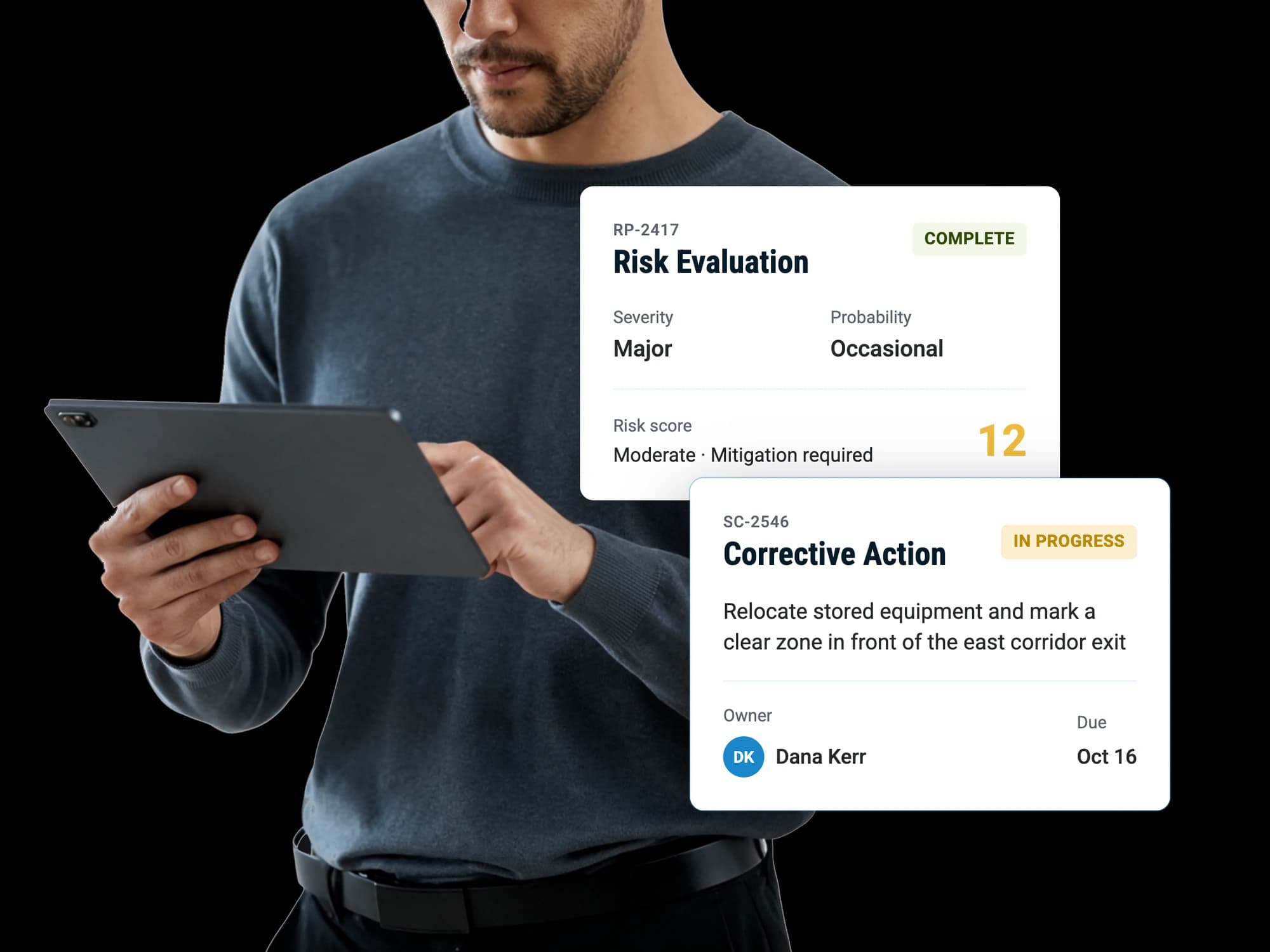
Step 3: Risk evaluation
Risk evaluation translates hazard descriptions into structured assessments. This step considers both severity and probability, informed by operational experience and available data.
This is where many organizations struggle. Risk scoring should be consistent, documented, and revisited as new information becomes available. Overly subjective or inconsistent scoring makes trend analysis unreliable.
Step 4: Aggregation and trend analysis
Actionable insights rarely emerge from single reports. They emerge from patterns. Aggregation allows safety personnel to identify:
-
Repeated hazards in the same operational area
-
Increases in report frequency
-
Shifts in risk ratings over time
This process aligns closely with broader discussions on how SMS helps identify systemic risk patterns.
Step 5: Decision-making and action
Insights must lead to decisions. These decisions may include:
-
Implementing or revising mitigations
-
Updating procedures or training
-
Adjusting oversight or audits
-
Escalating issues to senior management
Documentation of decisions is essential. It demonstrates that hazard data is being actively used, which is a key expectation during audits.
Practical examples from real-world operations
Consider a Part 135 operator receiving multiple hazard reports related to unstable approaches at a specific airport. Individually, each report may appear minor. Aggregated, they reveal a pattern tied to terrain, weather, and scheduling pressure.
An actionable insight might be that existing approach briefing guidance is insufficient. The resulting action could include revised briefing requirements, targeted training, or operational limitations under certain conditions.
In a Part 145 repair station, hazard reports may highlight repeated tool control discrepancies during shift changes. The insight may point to process gaps rather than individual performance issues. Action may involve procedural changes or shift overlap adjustments.
For Part 91 operators, hazard reports related to fatigue may reveal scheduling practices that increase risk during certain mission profiles. Insight leads to leadership discussion and policy adjustment rather than disciplinary action.
Common mistakes that prevent insights from emerging
Many organizations collect hazard reports but fail to generate insights due to predictable issues.
One common mistake is treating hazard reporting as a compliance task rather than an analytical input. When reports are filed and closed without synthesis, learning does not occur.
Another issue is overemphasis on individual events. Focusing only on the most recent or most serious report can obscure longer-term trends.
Lack of management engagement is also a barrier. If leadership does not routinely review hazard trends, insights remain isolated within the safety function.
Finally, inconsistent data structures undermine analysis. When categories, risk criteria, or review processes vary widely, meaningful aggregation becomes difficult.
What good implementation looks like
When hazard reports are effectively turned into actionable insights, several characteristics are usually present.
First, reporting is trusted. Personnel believe their input leads to improvement rather than punishment.
Second, analysis is routine. Hazard data is reviewed on a defined schedule, not only after incidents.
Third, insights are communicated. Findings are shared with appropriate stakeholders in a way that supports learning and awareness.
Fourth, actions are tracked. Mitigations are assigned, monitored, and revisited to confirm effectiveness.
Auditors often look for this closed-loop process when evaluating an SMS program, especially under Part 135 and Part 145 oversight.
How technology supports insight generation
Modern SMS platforms can support this process by structuring data, enabling trend analysis, and improving visibility. Technology does not replace judgment, but it can reduce administrative friction and improve consistency.
Common technology-supported capabilities include:
-
Standardized hazard categorization
-
Automated trend visualization
-
Risk tracking and mitigation status monitoring
-
Historical data comparison
The value lies in supporting informed decision-making, not in generating dashboards for their own sake. Technology should make it easier for safety managers and leadership to see what the data is saying and act accordingly.
Looking ahead
Turning hazard reports into actionable insights is not a one-time task. It is an ongoing capability that matures with experience, discipline, and leadership involvement.
As Safety Management Systems in business aviation continue to evolve, operators that consistently translate safety data into decisions will be better positioned to manage risk proactively. The goal is not more reports, but better understanding. When hazard reporting leads to insight, and insight leads to action, the SMS fulfills its intended role.