· 7 min read
How to Track Toolbox Talks Across Multiple Job Sites
By Michael Sidler, Founder, RISE

Monday morning, and last week's toolbox talk sheets are trickling in from six jobs: one folded in a truck door pocket, one with a coffee ring over the bottom three names. The sheet from job four never shows. Nobody can say whether the talk got skipped or the paper did.
Keep every talk from every site in one shared record, with the same fields each time: site, date, topic, who led it, who attended, and what the crew raised. Then review coverage site by site every week, while a gap is still a week old.
Why does paper fall apart once you run several jobs?
Each sign-in sheet records one meeting well. The trouble starts when you need an answer that spans all of them. Which subs missed the fall protection talk? Did the north job cover trenching before the excavator showed up? How many talks did the east site hold in March? On paper, each of those questions is an afternoon in the trailer with a stack of binders, and that assumes the binders are complete.
They rarely are. Sheets ride around on dashboards, get rained on, get filed under the wrong week, or get photographed and forgotten in someone's camera roll. The superintendent knows the talk happened. They were standing there. Proving it eight months later, for a talk on a job that has since closed out, is a different problem.
A sign-in sheet also captures the least useful part of the meeting. Names prove people were present. They say nothing about what the crew asked, what they pushed back on, or the guardrail somebody said was loose on level three.
What should every toolbox talk record capture?
The same short set of facts, on every site, every time. Consistency beats detail here, because the whole point is comparing six jobs side by side.
- Job site, date and time
- Topic, and who led the talk
- Every attendee, with their company, so sub crews show up as crews
- Anyone expected who was absent or excused
- Questions, concerns and hazards the crew raised
- Follow-up items, each with one owner and a due date
The concerns line is the one most forms skip, and it is the one that pays off. A NIOSH study of toolbox training in construction found that adding a narrative and discussion questions to a talk "significantly increased knowledge gain" compared with the standard version. If the conversation is where the learning happens, the conversation deserves a place on the record.
Keep the paper sign-in if your crews like it, and have each worker sign it themselves. A signature in the attendee's own hand is still the best thing a sheet can offer. Treat it as evidence attached to the record, not as the record.
How do you know every crew got covered?
You look, on a schedule, before anyone asks you to. Give one person, usually the safety manager, twenty minutes every Monday to go site by site through the previous week's talks. Three gaps matter most.
The first is a site with no talk at all. The second is a crew that keeps missing: the drywall sub that rolls in at 7:30, forty-five minutes after the talk wrapped up. The third is a topic a site never got, like the job that started steel erection without anyone covering struck-by hazards.
A shared topic calendar makes the third gap easy to spot. Run one calendar for the whole company so every site covers the core topics in the same weeks, and let superintendents add site-specific talks when the work changes: a trench opening, a crane arriving, a new sub mobilizing. A gap found on Monday is a phone call. A gap found during an incident review is a much harder conversation.
Watching six jobs from one desk has a lot in common with how consultants work across several clients: one consistent record per site, reviewed from one place, on a rhythm that does not depend on anyone remembering.
What happens to the concerns raised at the tailgate?
They get an owner and a date, or they evaporate. A concern said out loud at the tailgate and scribbled on the back of the sign-in sheet survives about as long as the coffee. By lunch the foreman is fighting a delivery problem, and by Friday the sheet is in a binder.
Write each item down as a task with one named person and a due date. One person, not "the site team." Then close the loop where it started: open the next talk by telling the crew what got fixed from last week's list. When a crew sees the loose guardrail repaired two days after they mentioned it, they mention the next thing. When nothing happens, they stop talking, and your talks turn into a reading of the handout.
What does this look like in RISE?
Toolbox talks run in Meeting Minutes. An Administrator builds the agenda once, starting from the RISE-written Toolbox Talk or Daily Toolbox Talk template or one of your own, and saves it as a template to reuse for every talk after that. Each talk gets its own date, time and location, so the job site sits on the record. Agenda items carry a presenter, and the notes under each item capture what was discussed, raised and decided. The signed paper sheet or the handout can go on the meeting as an attachment.
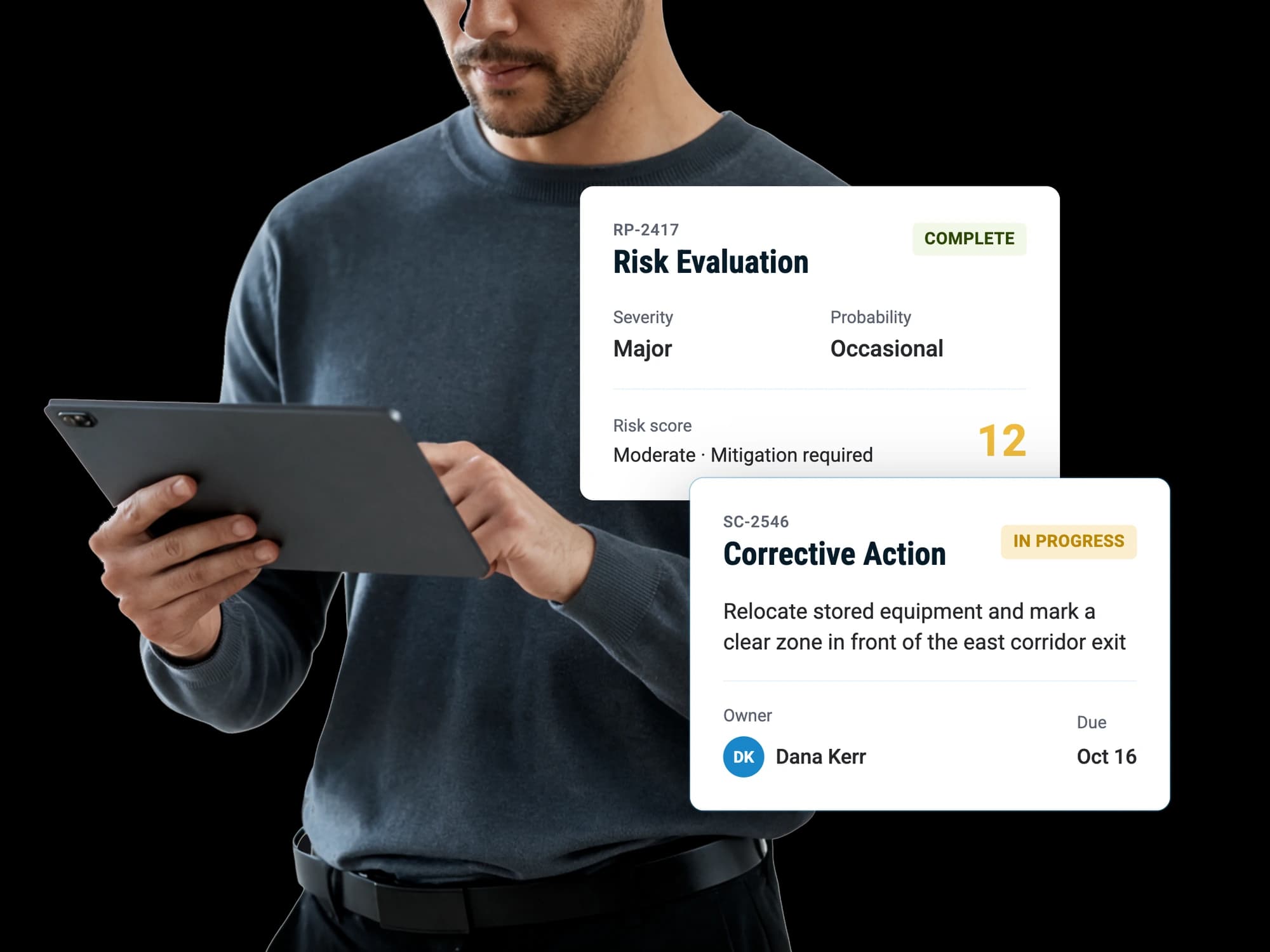
When the talk is completed, the Administrator running it marks each attendee present, absent or excused. Anything raised becomes a task with one owner and a due date, which lands in the Task Register linked back to the agenda item it came from. If it runs past due, the person assigned gets an overdue email. Minutes export to PDF when the owner's rep asks for them.
For the Monday review, meeting charts show talk activity across the account. A safety objective can carry an indicator that counts meetings against a target you set, and RISE records a breach and emails the right people when the target is crossed. With our RISE AI agent, you can ask in plain language which tasks are overdue and follow up in the same conversation.
Where to start this month
You can fix most of this before buying anything.
- Send every superintendent the six fields above this week. Same fields on every site, starting Monday.
- Build one topic calendar for the next quarter and share it across all jobs.
- Block twenty minutes every Monday for the coverage review, with a one-page list of sites down the side and weeks across the top.
- At the next talk on each site, pick one concern the crew raises, give it an owner and a date, and report back at the following talk.
When you want those records in one place, RISE keeps each toolbox talk's agenda, notes, attendance and follow-up tasks on a single meeting record for every site. Book a demo and we can walk through it with your own jobs.
Sources
Questions people ask
How often should toolbox talks happen on each job site?
Most contractors settle on one talk per site per week, with a short daily huddle when the work is changing fast. If an owner contract sets a frequency, build your topic calendar around it. The number matters less than holding it on every site, including the small job nobody visits.
Should subcontractor crews attend the general contractor's toolbox talk?
They should whenever they work around the same hazards your crews do, because a falling object does not check whose payroll you are on. Where a sub runs its own talks, ask their foreman to send you the same fields you collect from your own sites. Either way, record each attendee's company so you can see which crews are covered.
What do you do when a worker misses the toolbox talk?
Have the foreman cover the topic with them one-on-one before they start work, and record it as its own short talk with that worker present. Track who is marked absent or excused so repeat misses stand out in the Monday review. For workers with a RISE login, the minutes can go out as a promotion asking them to read and acknowledge by a due date.
Is a photo of the sign-in sheet a good enough record?
A clear photo is good evidence that people signed, and it is worth keeping. It is hard to search, though, so finding every talk a given crew attended means opening photos one by one. Pair each photo with a typed record of site, topic, attendees and concerns, and attach the photo to it.
How long should a toolbox talk run?
Ten to fifteen minutes is the usual range, long enough for a real discussion and short enough that the crew is still listening. Spend the time on one topic, a short story from real work, and a question or two that gets people talking. Reading a handout aloud fills the time without teaching much.