Last updated · 9 min read
What goes into a fleet safety program, and how to keep it running
By Michael Sidler, Founder, RISE
This article explains published regulations and is not legal or compliance advice. See the linked sources.
Verify against the current regulation at the primary source.
What actually goes into a fleet safety program? When researchers studied nine trucking companies that had turned their safety records around, the NSC summary put the main finding in one line: "None of the carriers that significantly improved safety implemented only one change."
That is the short answer to what goes into a fleet safety program. It is a set of working parts: leadership and written policy, careful driver selection, driver reports of crashes, near misses and hazards, vehicle and yard inspections, corrective actions that close, toolbox talks, and a few numbers everyone can see. Each part feeds the next, and your weekly job is keeping that loop turning, so a driver's report becomes a fix, the fix becomes a talk, and the talk shows up in the numbers.
What are the parts of a fleet safety program?
The best-known list comes from OSHA's employer guide, which lays out a ten-step program: senior management commitment and employee involvement, written policies and procedures, driver agreements, motor vehicle record checks, crash reporting and investigation, vehicle selection, maintenance and inspection, a disciplinary action system, a reward and incentive program, driver training and communication, and regulatory compliance.
It is a good list. It also reads like ten separate projects, and plenty of fleets run it that way: a policy written for the insurance renewal, an MVR pull at hire, a crash file in the safety office. Every piece exists. None of them connect.
Sort the ten into two piles. Some you set up and revisit once or twice a year: commitment, policies, agreements, record checks, discipline and rewards. The rest run every week: reporting, inspection, corrective action, training and communication. The weekly pile is where a program holds up or quietly stalls. The tenth step, working out which regulations govern your vehicles and drivers, is a conversation for your regulator and your counsel.
Set the foundation once, then keep it in sight
Policy is the part people write once and never read again. OSHA's guide suggests posting policies around the workplace, handing out copies periodically and discussing them at company meetings. A phone policy that lives in the onboarding packet is a policy a driver last saw the week they were hired.
Driver agreements and motor vehicle record checks belong in this pile too. The guide recommends that you "clearly define the number of violations an employee/driver can have before losing the privilege of driving for work." Write that number down before you need it. Decide it the afternoon a good driver's record comes back ugly, and you get a rule that bends for some drivers. Keep the signed agreement and the latest record review in each driver's file, with the next review date on the safety calendar.
Why are driver reports the engine of the program?
Drivers see the road, the docks and the customer yards every day. You see them through reports. OSHA's guide says "All crashes, regardless of severity, should be reported to the employee's supervisor as soon as feasible after the incident," and it calls understanding root causes, "regardless of fault," the basis for eliminating crashes. Fleets that get ahead of crashes stretch that habit to near misses and hazards: the customer lot with no room to swing a trailer, the dock plate that drops, the light out over the fuel island.
Drivers report when reporting is quicker than staying quiet. A phone call to a busy dispatcher is slow. A paper form at a terminal they pass twice a week is slower. Five questions and a photo, opened from a QR code inside the cab door, is fast. In RISE, a public form opens in a phone browser with no account, each form gets its own printable QR code, and anonymous reporting can be switched on for the forms where drivers may want it.
Someone has to read them. In RISE, a reviewer triages each report as a hazard, near miss, incident, accident or not a safety issue, and sets what happens next: no further action, a safety action, a risk evaluation or an investigation. For crash write-ups, our free incident report form records what happened, how severe it was and what to do next.
Then tell the driver what came of it. A driver who flags the same broken trailer latch two times and hears nothing will stop reporting issues altogether.
Vehicle inspections: where does the defect go next?
Most fleets do the inspection. The weak point is the hour after it. A driver writes up a chafed air line, the sheet goes in the tray, and what happens next depends on who reads the tray that night.
Treat every inspection finding as a corrective action with a name on it, including findings from your own monthly walk of the yard, the trailer pool, the forklifts and the dock doors. In RISE, inspections run from templates with your own response scale, can require evidence such as a photo on any item, link to an asset or work area (tractor 214, dock door 6), and repeat on a schedule. A finding raises a corrective action straight from the inspection, so nobody retypes it.
Your shop does the repair. The corrective action records who owns the fix and by when, and with verified closure switched on for a task, it also records who checked it.
Corrective actions are where programs stall
An action with no owner is a wish. Every action from a crash review, a driver report or an inspection gets one named owner, a due date and a way to prove it was done. "Maintenance" is a department, not an owner. So is "ops."
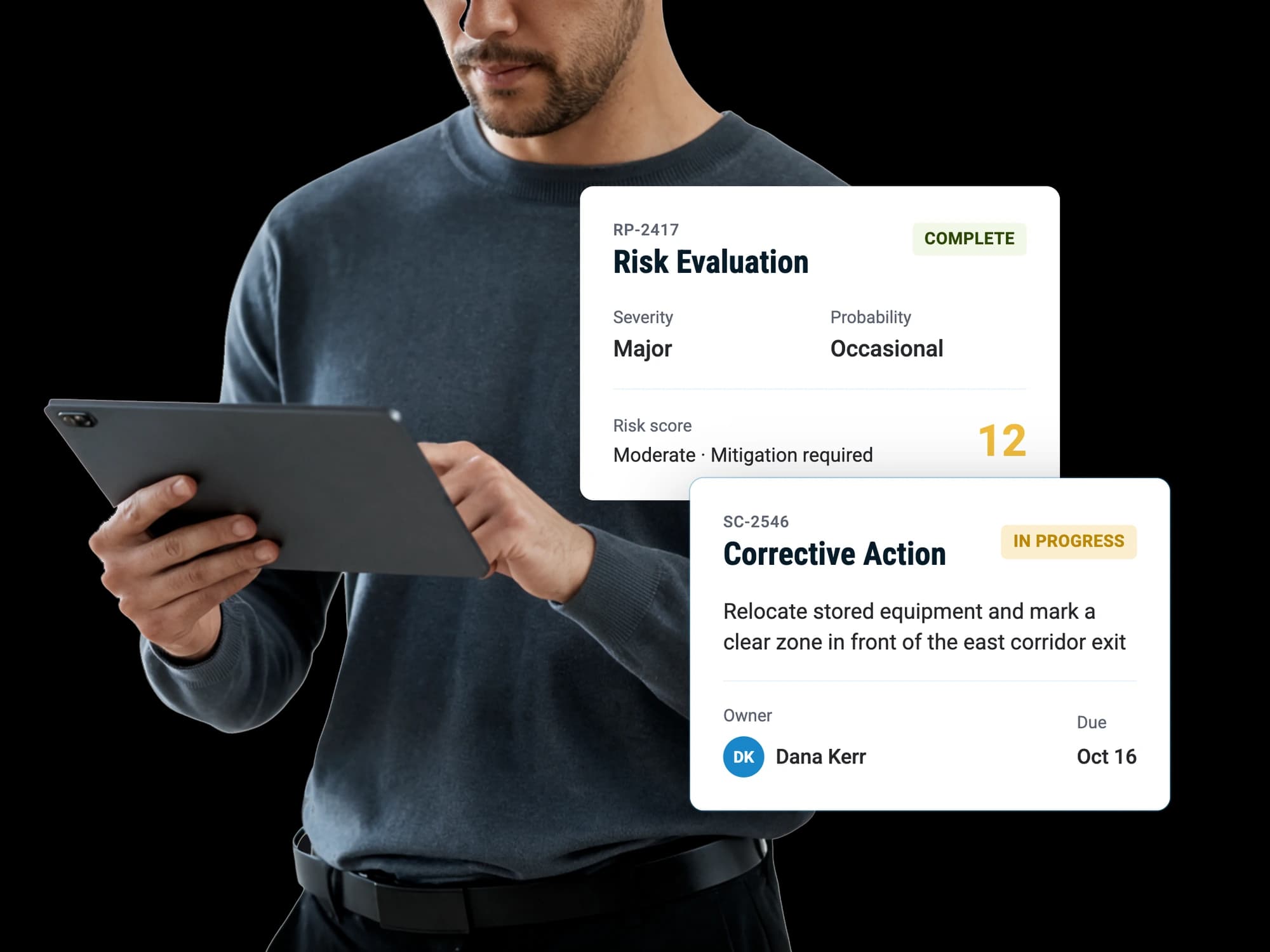
In RISE, every task, corrective actions included, sits in the Task Register with one owner, a priority, start and due dates, and a link back to the report, inspection or meeting it came from. When a task passes its due date, the person assigned gets an overdue email. Verified closure can be switched on per task, so closing it takes a note, a file or a linked record, and the verifier is recorded.
The weekly habit matters more than any system: fifteen minutes every Monday with the operations manager and the shop lead, open actions sorted oldest first, overdue ones raised by name. Oldest first is the trick. New actions get attention on their own.
Toolbox talks: tell drivers what their reports changed
The toolbox talk is where the loop closes. Pick the topic from last week's reports: the near miss at the customer dock, the trailer latch that finally got fixed, the new backing rule at the cross-dock. Drivers keep reporting when they hear a report turned into something.
Weekly is realistic. In the OSHA guide's case studies, an asphalt paving company had all drivers attend weekly toolbox talks on fleet safety, and reported more than two million miles in 2003 without a significant roadway incident.
Drivers on different schedules rarely fit in one room, so run the same short talk at each shift start or on the days regional drivers come through. In RISE, talks run in Meeting Minutes: an Administrator saves the agenda as a template, records the topics and decisions for each talk, raises tasks with owners and due dates, and marks who attended when the talk is completed.
Which numbers show the program is working?
A handful you can act on, shared with the people doing the work. The NSC study lists "sharing carrier-wide safety indicators with managers and drivers" among the practices behind a strong safety culture. Put them on the dispatch board.
Driver reports per week should climb in the first months: more reports usually means more trust, not more danger. Then track overdue corrective actions, average days to close, and inspection findings per unit, which shows which tractors and trailers keep coming back. Preventable crashes stay on the board as the lagging number. In RISE, safety objectives carry indicators (SPIs) and targets (SPTs), and indicators count your own records and are recalculated nightly, so the numbers show whether the operation is actually getting safer and someone can act on them.
In RISE, safety performance indicators count records such as reports, tasks and meetings, and recalculate nightly. Set a target, and when an indicator crosses it, RISE records a breach and emails the people who need to know. An add-on available on any plan lets you ask plain-language questions about your own records, such as which units had the most inspection findings this quarter.
Where to start this month
Start with the weekly loop. The once-a-year pile can wait a month.
- Print a QR code for a short driver report form and put it where drivers already stop: the cab door, the fuel island, the dispatch window, the DC break room.
- Pull every open defect and action into one list and give each one a single owner and a date.
- Choose next week's toolbox talk from last week's reports, and credit the driver who raised it if they are happy to be named.
- Pick three numbers and post them where drivers and dispatchers both see them.
RISE keeps driver reports, inspections, corrective actions and toolbox talks in one place, with every action linked back to where it started. To see that loop with your own forms, book a demo.
Sources
- OSHA: Guidelines for Employers to Reduce Motor Vehicle Crashes
- National Safety Council: Study: Comprehensive Approach Needed to Improve Trucking Safety
Questions people ask
How big does a fleet need to be before it needs a formal fleet safety program?
A written program earns its keep once you have more drivers than one person can talk to face to face every week. Below that, the owner is often the program, and it holds up until that person takes a vacation. The parts scale down well: a one-page policy, one report form, one open-actions list and a regular talk. Whether any rule calls for a program in your operation is a question for your regulator.
Who should own the fleet safety program, safety or operations?
The safety director runs it, and operations owns most of the fixes. Dispatch sets schedules, the shop decides when a truck is fit to go, and terminal managers own the yard and docks, so the program needs a seat in each of those meetings. Several carriers in the NSC study reported benefits from getting buy-in from operations and dispatch as well as drivers. A program that lives entirely in the safety office ends up writing reports to itself.
Should driver safety reports be anonymous?
Offer anonymity as a choice and expect most drivers to put their names on most reports. The anonymous option matters for the reports drivers worry about: a dispatcher pushing a tight window, a customer's unsafe yard, a coworker's habits. Named reports are easier to follow up, so thank people by name when they let you. In RISE, anonymous reporting is switched on per form and the reporter decides when they file.
Do dash cameras and telematics replace a fleet safety program?
They feed it. Cameras and telematics produce events such as hard braking, close following and lane departures, and the program decides what happens next: who coaches the driver, what gets fixed, and whether the pattern becomes next week's talk. The carriers in the NSC study reviewed crash data and information from their safety technology to work on problem areas before crashes happened.
How does a fleet safety program relate to a safety management system?
A fleet safety program is a safety management system applied to drivers, vehicles and yards. The SMS frame adds structure: a policy, a way to assess risk, assurance that controls work, and promotion that keeps people involved. Fleets that think in those terms tend to look for patterns across crashes instead of treating each one as a one-off. Our free guide The Safety Program That Lasts walks through building one, chapter by chapter.